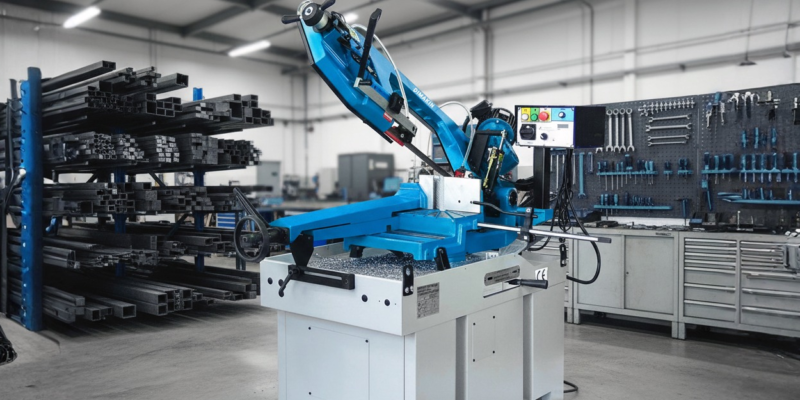
Dimakin explains – Bandsaws are a core piece of equipment in metal fabrication, maintenance, and production environments. When a bandsaw cuts accurately, it improves fit-up, reduces secondary machining, and keeps production moving efficiently. When cutting accuracy drops, the impact is immediate, uneven cuts, higher scrap rates, and longer cycle times.
Understanding why bandsaw cutting accuracy declines, and how to correct it quickly, allows workshops to restore performance without unnecessary downtime or trial-and-error adjustments.
Recognising the Early Signs of Accuracy Loss
Loss of cutting accuracy rarely happens overnight. In most cases, clear warning signs appear before cuts fall outside tolerance.
Common symptoms include angled or tapered cuts, rough or inconsistent surfaces, blade wandering, excessive burr formation, and inconsistent cut lengths. Operators may also notice increased vibration, chatter, or unusual blade noise. These symptoms usually point to issues with blade condition, setup, alignment, or feed control.
Identifying and addressing the root cause early prevents minor issues from turning into costly production disruptions.
Worn or Incorrect Bandsaw Blades
Blade condition is one of the most frequent causes of poor cutting accuracy. A worn bandsaw blade struggles to maintain a straight cutting path, particularly when cutting thicker sections or higher-strength materials.
Using an incorrect blade specification has a similar effect. Fine-tooth blades tend to clog when cutting thicker material, while coarse-pitch blades struggle to maintain stability on thin sections. Both conditions increase cutting resistance, leading to blade deflection and reduced accuracy.
Replacing worn blades promptly and selecting the correct tooth pitch, geometry, and blade width for the material being cut is one of the fastest ways to restore accuracy and improve surface finish.
Incorrect Blade Tension
Blade tension has a direct and significant impact on cutting accuracy. Under-tensioned blades flex during cutting, causing wandering cuts and uneven edges. Excessive tension, however, accelerates blade fatigue and places unnecessary load on bearings and wheels.
Always follow the manufacturer’s recommended tension settings and check tension regularly, particularly after blade changes. Consistent, correct tension helps the blade track properly and maintain a straight cutting path.
On manual horizontal bandsaws, especially machines offering both hydraulic and manual bow descent, correct blade tension is particularly important to compensate for variations in cutting pressure introduced by operator control.


Misalignment of Blade Guides and Bearings
Blade guides and bearings are responsible for keeping the blade correctly supported throughout the cut. When guides wear, shift, or become contaminated with swarf, cutting accuracy quickly deteriorates.
Inspect guides for wear, damage, or debris buildup, and ensure they are correctly aligned. Even small deviations can cause the blade to drift under load. Bearings should rotate freely without excessive play, and guide arms should be positioned as close to the workpiece as practical to minimise unsupported blade length.
Regular inspection and adjustment of guides and bearings is one of the quickest and most effective ways to restore cutting precision.
Inconsistent Feed Rate and Bow Descent Control
Inconsistent feed rate is a common contributor to poor accuracy, particularly on manual bandsaws. Feeding too aggressively increases blade deflection, while feeding too lightly generates excess heat and accelerates blade wear.
Controlled bow descent systems regulate feed pressure, allowing the blade to cut efficiently rather than being forced through the material. This becomes increasingly important when cutting thicker sections, stainless steels, or tougher alloys.
Manual bandsaws such as DIMAKIN’s BS-270-SM and BS-310-SM, which offer hydraulic or manual descent options, allow operators to fine-tune feed pressure to suit different materials, improving accuracy and repeatability across multiple cuts.
Poor Workpiece Clamping
Even a well-set bandsaw cannot cut accurately if the workpiece is not clamped securely. Insufficient clamping allows the material to vibrate or shift during cutting, resulting in angled or uneven cuts.
Ensure the vice grips the workpiece firmly and sits square to the blade. Clean all contact surfaces and avoid clamping on burrs, scale, or uneven edges. For mitre cutting, confirm both the vice position and cutting angle are correctly set before starting the cut.
Stable, square clamping is essential for consistent cutting accuracy.
Machine Rigidity and Structural Stability
Machine rigidity plays a major role in maintaining cutting accuracy, particularly when working with larger or heavier material sections. Lightweight or worn frames can flex under load, causing blade deviation and inconsistent cuts.
Rigid horizontal bandsaws are better able to resist deflection and maintain alignment throughout the cutting cycle. Higher-capacity machines, such as DIMAKIN’s BS-420-DM and BS-500-DM dual-mitre bandsaws, are designed with increased structural stability to support straighter cuts under higher cutting loads.
As material size and cutting forces increase, frame rigidity becomes increasingly critical to maintaining accuracy.


Manual vs Semi-Automatic Bandsaw Operation
Accuracy challenges differ between manual and semi-automatic bandsaws. Manual machines rely more heavily on operator input, making consistent setup, feed adjustment, and clamping discipline essential.
Semi-automatic bandsaws reduce variability by automating key functions such as bow descent, vice clamping, and bow return. Machines like the BS-500-DM-SA and BS-600-DM-SA apply controlled, repeatable feed pressure, improving cutting consistency and reducing operator-induced variation during longer production runs.
Choosing the appropriate level of automation helps workshops balance accuracy, throughput, and operational efficiency.
Preventive Maintenance Restores Accuracy Faster
Preventive maintenance is one of the most effective ways to correct and prevent accuracy issues. Routine cleaning, lubrication, and inspection help prevent small faults from escalating into major performance problems.
Regularly check blade guides, descent systems, clamping mechanisms, and moving components. Replace worn parts early and keep cutting areas clear of swarf and debris. A well-maintained bandsaw delivers more consistent cuts, longer blade life, and reduced downtime.
Achieving Consistent Bandsaw Cutting Performance
While the fundamentals of bandsaw cutting remain consistent, the engineering behind each machine has a direct impact on achievable accuracy. Structural rigidity, controlled feed systems, and reliable clamping all contribute to repeatable cutting performance.