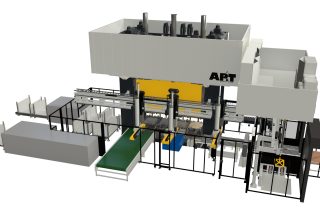
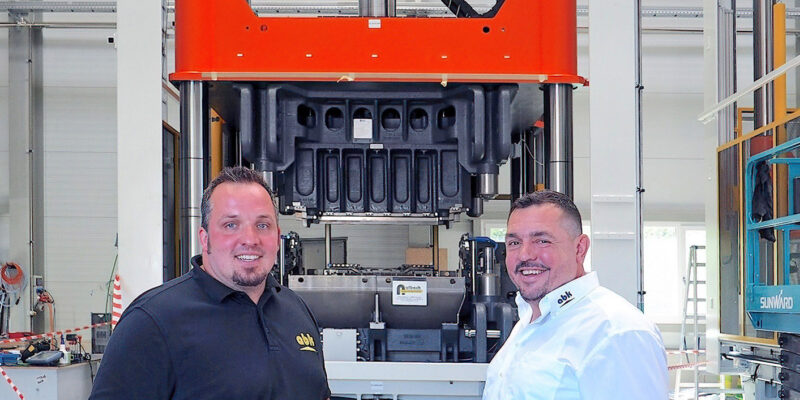
Located in the German, Aulbach Automation is a market leader in the manufacture of presses for trimming large castings. For more than a decade, it has relied on powered die changing systems, ball and roller bars, and die clamping elements from Roemheld whose UK subsidiary in Cramlington serves the British and Irish markets.
In modern mega- or giga-casting processes, a large, single-piece structural component is made of die-cast aluminium – anything from an individual subframe to an entire battery housing or a complete front or rear undercarriage. It replaces dozens of individual components, sometimes more than 100, that are normally welded together to form an assembly. The technology, pioneered by Tesla and now used by numerous vehicle manufacturers globally, simplifies production, reduces weight and improves rigidity.
However, the large component formats and heavy weights place extreme demands on post-processing operations. Aulbach Automation understands this well, as the 70-employee company specialises in the manufacture of trimming presses for the foundry industry. It has been working in the mega- and giga-casting sector since 2021 and by September 2025 had delivered 23 four-column presses for shearing off excess aluminium flash and other overflow material from castings measuring more than 3 x 2.5 metres.
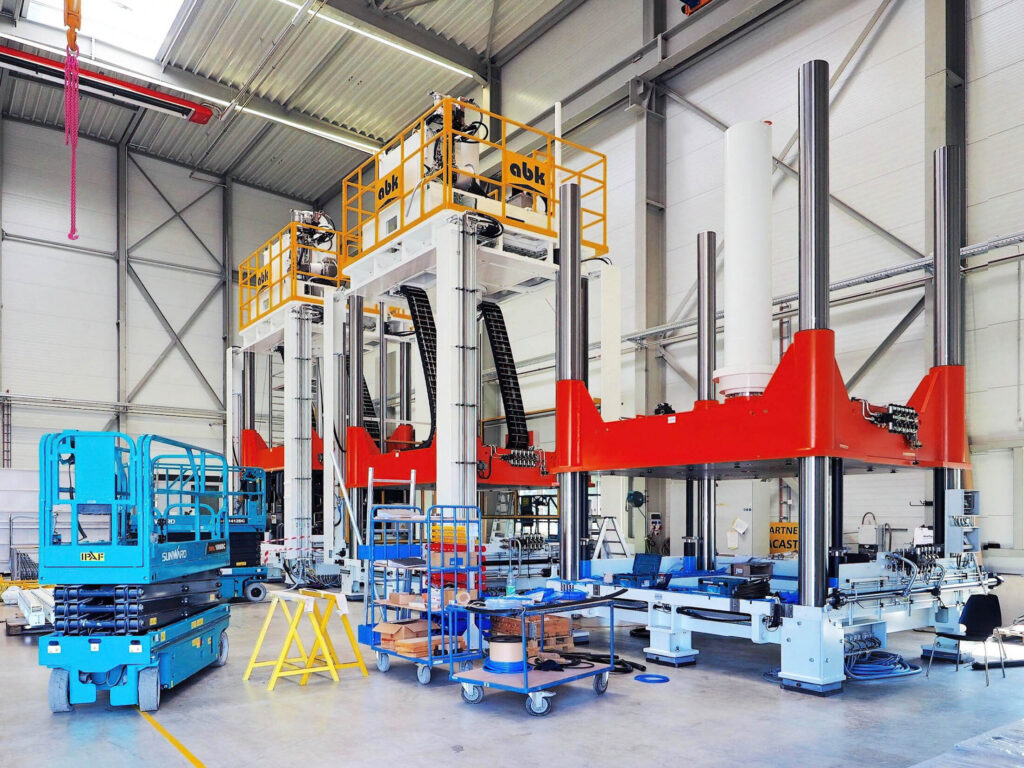
André Pfeifer, technical project manager at Aulbach Automation said, “In our view, there are many reasons to choose Roemheld products, including their precision, reliability and durability. In addition, the coordination of the elements with each other is excellent, delivery times are short and the service is impressive.”
The main advantages of automated die changing, including for trimming castings, are reduced set-up times and increased reliability. The focus on the presses that Aulbach Automation supplies is on the accuracy of the changeover process. If dies are positioned inaccurately or clamped incorrectly, they can easily be damaged, or faulty components can be produced. In addition, with Roemheld products an operator benefits from high levels of ergonomics and safety.
The table surface of an Aulbach Automation press incorporates Roemheld transport rails that feature hydraulic ball or roller bars that lift to allow the heavy lower part of the die set to roll in smoothly. Once it is aligned, the rails lower and the die rests flat on the press table. Set into the table are hydraulically-actuated, double-acting, swivelling clamping elements, also supplied by Roemheld.
To avoid interference, the clamps are rotated out of the way at a 45-degree angle while the die is being rolled into place. Once sensors confirm the die is in the correct position, the clamps rotate through 45 degrees and move downwards over the die edge with a force of between 60 and 412 kN. They are engineered to tolerate slight misalignments or edge variances of up to 1.5 mm.
The upper half of the deflashing die must similarly be secured rigidly to the press ram. In this case, 90-degree hydraulic swivel clamps swing over the upper die and lock it to the ram surface, maintaining tight tolerances within a few tenths of a millimetre. As any slight misalignment with the lower die would cause catastrophic damage to the expensive tool and probably scrap the casting as the ram descends with typically 400 tonnes-force, the clamping system relies on a central Roemheld hydraulic unit equipped with electronic monitoring.
Inductive proximity switches continuously monitor the precise physical location of the clamp, electronically verifying three distinct states: released, rotated, and clamped. If one sensor records a fault, the press is instantly locked out. The swivel mechanism is additionally protected by a spring-loaded overload device and a manual emergency control is in place in case of a sudden power outage.
Mega- and giga-casting lines are costly and lost production during stoppages is expensive. Monitoring upper and lower hydraulic clamping of deflashing die sets during automated changeover and linking it to a centralised control panel to oversee the processes allows an operator to swap the multi-tonne tools in minutes rather than hours, radically increasing factory throughput.