Defense budgets are moving up across NATO-aligned countries, but higher spending alone does not create military capability. Ships, vehicles, and critical infrastructure still have to be fabricated, welded, inspected, and delivered. That is where the real constraint often appears. The industrial base may be asked to produce more, faster, and with tighter quality requirements than before, while simultaneously contending with labor shortages, aging workforces, and uneven production capacity across regions.
This is why the discussion around defense manufacturing has grown more substantive in recent years. Governments are no longer speaking only about procurement plans. The conversation now extends to domestic production capability, supply chain resilience, and the ability to sustain long-term programs at home. Canada’s Defence Industrial Strategy is one example of this broader shift. It places security, sovereignty, and industrial capacity within the same framework, with substantial commitments to rebuilding national capability.
For companies involved in heavy fabrication, this matters directly. Rising demand is valuable only if production systems can respond with predictable quality and schedule performance. In defense-linked industries, that often comes down to a straightforward question: can the fabrication process deliver consistent output at scale?
Why welding capability matters more than policy language
Naval construction, armored vehicle production, and many forms of strategic infrastructure all depend on welded structures. In these environments, quality carries more weight than a simple technical requirement. It governs structural performance, inspection outcomes, rework levels, and delivery confidence. Inconsistent welding spreads its effects quickly through the production chain.
In shipbuilding, that problem becomes especially visible. Flat panels and large assemblies must be produced with accuracy and repeatability so that downstream stages do not absorb unnecessary delays. Poor distortion control or excessive weld variation drives schedule risk upward. Rework then consumes skilled labor that is already difficult to source, eroding not just efficiency but delivery reliability.
Robotic welding automation deserves to be understood in a broader context. Beyond productivity improvement, it functions in many environments as a component of industrial readiness. Better repeatability, more stable processes, and a more transparent production flow help manufacturers convert demand into actual output. When defense programs face pressure, those gains take on strategic weight.
The same logic holds outside shipbuilding. Military mobility platforms, support vehicles, field shelters, steel bridge systems, offshore energy assets with security implications, and strategic industrial infrastructure all rely on welding quality sustained across long production runs. Manufacturers that depend heavily on manual variation expose themselves to compounding inconsistency as output scales. That affects more than cost. It undermines confidence.
Industrial readiness is built on production discipline
One of the common errors in public discussion is treating defense spending and manufacturing capability as separate subjects. In practice, they are tightly interconnected. A country can authorize major programs, but if the industrial base lacks the production discipline to support them, the result will be delay, bottlenecks, and cost growth rather than readiness.
Factory modernization addresses this directly.
Panel line solutions, automated welding systems, and better-controlled fabrication processes reduce unnecessary variability in large steel production. Throughput becomes more predictable, and quality becomes easier to sustain. This does not eliminate the need for skilled people. It gives them a production environment where their capabilities can scale more effectively.
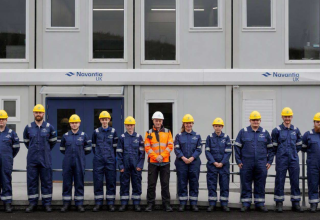
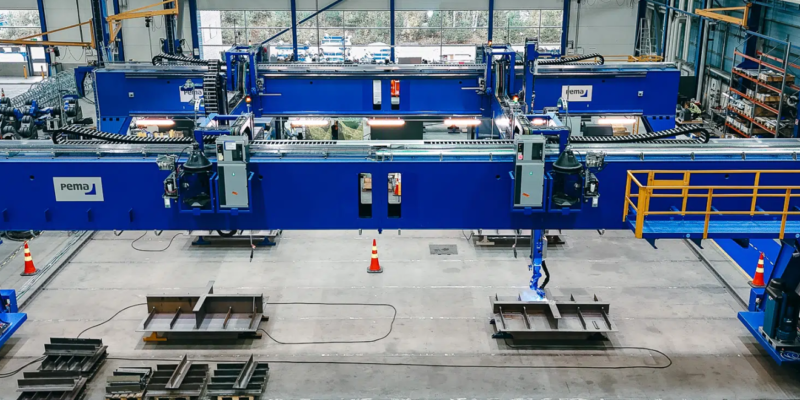
Pemamek recently completed factory acceptance tests on advanced panel line equipment built for Navantia UK and the UK Ministry of Defence as part of the Harland and Wolff modernisation project. This milestone represents automation entering defence-linked shipbuilding in a consequential way. The panel line will be housed within an extended fabrication hall, with a 5,000-square-metre expansion to the existing facilities currently under construction and scheduled for completion in 2026. This will enable concurrent build programmes and significantly increase the yard’s capacity for complex naval construction.
That project is instructive for what it signals about the wider market. Modernization in a defense-linked shipyard is not simply a matter of replacing aging machinery. It reflects a deeper recognition that future workloads cannot be carried by legacy production models. Yards expected to deliver more complex structures, at greater speed, under tighter labor conditions, need fabrication that is both more stable and more measurable.
Capacity problems usually begin upstream
In many large manufacturing environments, the most visible bottlenecks appear late. Assembly slips. Delivery dates move. Inspection queues accumulate. The causes, however, often originate much earlier, in how panels, profiles, and welded subassemblies are produced. When upstream fabrication is uneven, downstream teams inherit the instability. Schedules become harder to trust, because each stage depends on absorbing variation introduced at an earlier point.
This is why panel line capability carries such weight in naval and heavy steel production. When flat panels are fabricated with greater consistency, the benefit extends well beyond that single process step. Fit-up improves. Rework falls. Material handling grows more predictable.
Downstream welding and assembly proceed with fewer interruptions. In practice, this creates a more controlled production environment, which is precisely what long-term defense programs require.
Pemamek’s work in shipbuilding has demonstrated this pattern repeatedly. Through project updates and customer stories, the same dynamic emerges across different geographies and yard configurations. When manufacturers invest in better-controlled welding and panel fabrication, the value does not stay confined to a single machine or cell. It changes the reliability of the entire production chain.
Many Western yards now face a dual mandate: ramp up output while reducing dependence on unpredictable manual variation. That is not a contradiction, but it does require a deliberate production strategy. Capacity is not simply a measure of square meters or installed tonnage. It is the ability to produce to standard, repeatedly, under sustained demand.
The labor question is real, but it is not the full picture
Much of the conversation around automation begins with workforce shortage, and with good reason. Many manufacturers struggle to recruit sufficient skilled welders and fitters. In some markets, retirements are accelerating faster than new entrants can be trained. In others, energy, infrastructure, and defense programs compete for the same labor pool. This is already affecting delivery performance.
Even so, labor availability represents only part of the problem. Even when skilled people are available, relying on manual execution for repeatable, high-volume welding tasks generates avoidable variation. Every operator brings experience and judgment, but also differences in pace, technique, and consistency. In one-off fabrication, this variability may be manageable. In long production programs with strict quality expectations, it becomes progressively harder to absorb.
Automation supports rather than displaces expertise in this context. The objective is not to remove skilled people from the process. It is to deploy their knowledge where it creates the most value, and to give them systems that reduce repetitive variability. In large panel lines and high-volume welding applications, that can mean more consistent travel speed, controlled heat input, repeatable weld placement, and a more dependable relationship between production planning and actual output.
Pemamek customer accounts return to this practical outcome consistently. Companies invest in automation not because the technology is new. They do it because they need more predictable production, improved weld consistency, and better utilization of available labor. In industries where tolerances, distortion management, and schedule discipline all carry real consequences, these are operational necessities rather than aspirations.
Defense supply chains are only as strong as their fabrication base
A second error in defense analysis is to focus too narrowly on prime contractors and final assembly. Major programs draw on much broader industrial ecosystems. Steel fabricators, panel producers, heavy equipment manufacturers, system integrators, and specialist subcontractors all contribute to the final result. When that network lacks production stability, program risk rises throughout the chain.
This is especially pertinent for countries working to strengthen sovereign manufacturing capability. Domestic industrial capacity is not built through final procurement decisions alone. Investment in the production layers beneath them is equally essential. When those layers remain fragmented, under-automated, or reliant on rework-intensive methods, strategic ambition will consistently outpace practical delivery.
Canada’s industrial strategy emphasizes sovereignty and prosperity, but the underlying manufacturing challenge is common across many allied nations. What does it actually take for domestic industry to carry strategic workloads?
The answer is not simply more demand. Demand without capability generates pressure, not resilience. Capability comes from trained people, disciplined processes, and production systems designed for repeatable output.
This is why automation belongs within industrial policy thinking, not just plant-level efficiency discussions. A nation does not improve readiness by announcing output targets. It improves readiness by ensuring the factories and supplier networks behind those targets can fabricate to the required standard.
Lessons from heavy industry apply directly to defense-linked production
Pemamek’s perspective on this subject draws from practical involvement in sectors where these questions are most acute. The underlying production challenges in shipbuilding, offshore fabrication, bridge manufacturing, wind towers, and other heavy steel sectors share common fundamentals. Large welded structures demand process control. Distortion must be managed. Throughput must be planned against realistic process times. Quality must be built into the production flow, not verified after the fact.
Manual bottlenecks restrict throughput. Quality variation generates rework. Production planning loses credibility when process times depend too heavily on individual execution. Modernization becomes necessary not for its own sake, but for operational viability.
These lessons transfer directly into defense-linked manufacturing. The sectors differ in regulation, procurement structure, and end use, but steel does not become easier to fabricate because the buyer is a defense ministry. Documentation, traceability, and confidence in repeatable execution become more demanding. Disciplined fabrication therefore becomes more valuable, not less.
Technology is not the point. Production confidence is.
Any conversation of this kind risks becoming too focused on equipment categories: robotics, panel lines, welding stations, software layers, material handling systems. These are all important, but they are instruments rather than objectives. The real issue is production confidence.
- Can a yard or fabrication plant commit to a schedule and believe in it?
- Can it produce repeatable quality across shifts and over multi-year programs?
- Can it increase output without losing control of distortion, inspection performance, or downstream fit-up?
- Can it make better use of scarce welding expertise rather than spending that expertise correcting avoidable rework?
When manufacturers invest in automated welding and panel line solutions, those are often the questions they are actually trying to answer. The goal is to reduce unpredictability in environments where unpredictability is expensive. In defense-linked sectors, that unpredictability can also carry strategic consequences.
“As a leader in designing, building, assembling, maintaining, and upgrading international warships, this requires constant adaptation of advanced manufacturing techniques and continual development of our people, processes, and culture,”
Industrial modernisation is now part of the national capability
It was once reasonable to treat factory modernisation as a private operational matter. That framing no longer holds. As geopolitical pressure intensifies and governments ask more of domestic industry, production capability has become part of a wider national question.
This does not mean every factory investment warrants framing as state policy. It does mean industrial capability deserves more rigorous attention than it typically receives. The strength of a defense manufacturing base is not measured only by contracts signed or budgets allocated. The measure is whether material flows, weld quality, throughput, and delivery discipline can hold under sustained demand.
Pemamek’s position in this discussion comes from direct involvement in the sectors where those questions are most visible. Across shipbuilding modernization projects and heavy fabrication work, a consistent pattern emerges. Manufacturers that need dependable output are moving toward more controlled, repeatable production methods, not because the trend is compelling on paper, but because the old assumptions have stopped delivering.
There will remain contexts where manual methods are appropriate, and tasks that require experienced human judgment will not disappear. For large-volume, repeatable welding applications in industries with strategic significance, the direction is clear. When production must scale without sacrificing quality, process variability must come down.
The real question behind rising defense budgets
As governments push for stronger domestic defense capacity, the next challenge is no longer primarily financial. It is industrial. Can fabrication systems produce what policy now demands, with enough consistency to support long programs and evolving security requirements?
That question extends well beyond shipyards. It applies across supply chains that support defense, energy security, and other sectors with strategic significance. Companies that invest in production stability, welding quality, and scalable fabrication capacity are not simply improving their own operations. They are contributing to a broader industrial capability that many nations now say they need.
In the coming years, that may be the clearest measure of preparedness. Not what has been promised on paper, but what the industrial base can actually build. If allied nations are serious about sovereignty, resilience, and readiness, the condition of their fabrication base warrants the same scrutiny as the scale of their budgets. The harder question is not whether more funding is available. It is whether enough has been done to turn that funding into reliable industrial output.