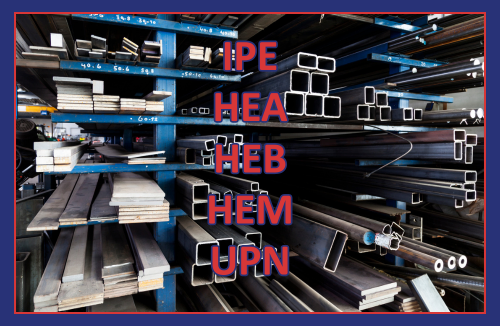
Structural drawings, material schedules and project specifications across Europe frequently reference IPE, HEA, HEB, HEM, and UPN steel sections. The designations can appear similar, yet each identifies a distinct profile with its own geometry, dimensions, and structural properties. Recognising these differences is important when specifications cross UK and Continental European standards. A closer look at the different section types helps clarify how IPE, HEA, HEB, HEM, and UPN profiles compare, the structural roles they typically perform, and the applications in which they are commonly used.
UK vs. Continental Steel Sections: Key Conceptual Differences
British and Continental European structural sections can fulfil similar roles within a steel structure, but their dimensions and design conventions are not necessarily the same. UK sections covered by standards such as BS 4-1 have their origins in historic imperial sizes that were later converted to metric dimensions. Continental European profiles, in contrast, use standardised metric proportions and tend to be specified alongside European structural steel requirements, including EN 10025.
Several UK section types have broadly comparable Continental counterparts:
- Universal Beams (UB) can correspond to IPE beam sections
- Universal Columns (UC) has similarities with HEA, HEB, and HEM sections
- Parallel Flange Channels (PFC) perform comparable roles to UPN channel sections.
These similarities are useful when interpreting specifications; however they do not mean that the sections are dimensionally interchangeable. Section dimensions and structural properties must therefore be checked before any substitution is made. Material grade is another consideration, with S235, S275, and S355 among the grades commonly associated with continental steel sections, depending on specification and performance.
European I-Beams: IPE Sections
IPE sections are European I-beams characterised by parallel flange surfaces, a relatively deep web, and narrower flanges compared with HE profiles of a similar size. A higher depth-to-width ratio concentrates material efficiently around the major bending axis, helping the section achieve strong flexural performance while limiting unnecessary mass.
Mechanically, IPE profiles provide high resistance to major-axis bending, especially in structures where vertical loads generate significant bending moments. This characteristic allows IPE sections to carry loads effectively across a span, enabling widespread use of horizontal and inclined structural members.
Typical engineering applications of IPE sections include:
- Floor joists supporting concrete or composite floor systems
- Roof rafters carrying roof coverings and imposed loads
- Purlins forming part of industrial roofing systems
- Secondary beams transferring floor loads into primary frames.
Consequently, IPE continental steel sections are frequently specified where efficient beam action is more important than the broad flange area typical of column-focused profiles.
European H-Beams: HEA, HEB, and HEM Sections
European HE sections have broad H-shaped profiles with wider flanges than IPE beams. Their geometry delivers strong performance under axial compression and improved stability for applications in which lateral-torsional buckling, column loading, or substantial structural forces influence section selection.
HEA
HEA represents the lighter series within the HE family. Comparatively thin webs and flanges reduce weight per metre, providing a relatively lightweight wide-flange profile for moderate structural loads. Because its low weight can decrease material requirements, HEA sections suit lower-load building frameworks, moderately loaded columns, mezzanine structures, and roof-support frames where the design does not require a heavier section.
HEB
HEB sections provide greater web and flange thickness than equivalent HEA profiles. Possessing balanced proportions, HEB sections combine increased structural capacity with a practical section weight, which makes the series a practical choice for general load-bearing constructions. Standard applications of HEB sections include primary building columns, portal-frame members, transfer structures, industrial platforms, and civil engineering frameworks carrying substantial vertical or combined loads.
HEM
HEM profiles occupy the heavy end of the HE range. Significantly thicker webs and flanges increase cross-sectional area, mass per metre, stiffness, and load-bearing capability for a comparable nominal section depth. Heavy industrial buildings, highly loaded columns, high-rise structural systems, crane-support structures, and major engineering installations require HEM sections where concentrated or sustained loads are particularly demanding.
European Channel Sections: UPN Profiles
UPN profiles are standardised European U-channels with a C- or U-shaped cross-section. A defining geometric feature is their tapered inner flange surfaces, which distinguish traditional UPN sections from the parallel internal flange arrangement found on UK PFC profiles.
Structurally, UPN channels provide reliable single-axis support and offer considerable fabrication flexibility. Designers can also pair or weld channels back-to-back when a built-up member is required for a particular loading arrangement.
Practical applications of UPN profiles include:
- Building-frame members
- Masonry lintels
- Wall-cladding supports
- Truck and trailer chassis components
- Machinery beds
- Equipment frames
- Steel stair stringers.
Connection design must account for a UPN profile’s tapered flange geometry if plates, bolts, or welded details interface with the channel.
Reach Out To Masteel UK For Continental Steel Section Selection
The distinction between IPE, HEA, HEB, HEM, and UPN sections comes down to not only their characteristic shapes, but also to differences in flange width, web and flange thickness, section mass, and structural properties. For projects requiring Continental European sections, Masteel UK offers these profile families in a range of structural steel grades, supported by in-house processing and testing capabilities. Material supply and project logistics can also be coordinated for fabrication programmes in the UK and internationally. To receive additional support sourcing continental steel sections, contact Masteel UK’s team to discuss your upcoming project.