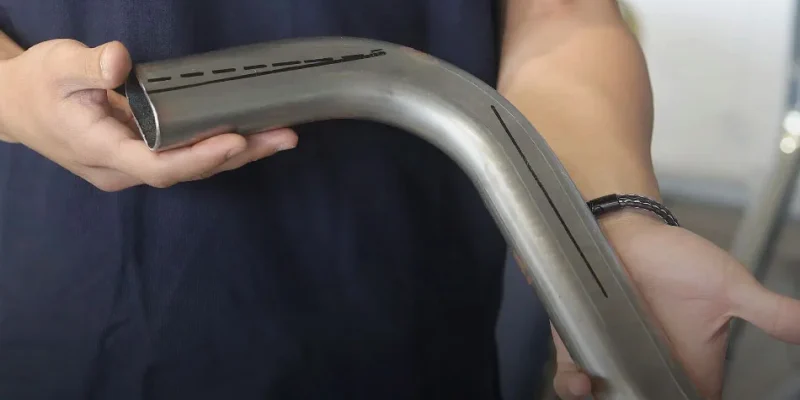
A tube can look right while it is held in the tooling, then open out slightly once released. This is springback, a normal part of metal forming that needs to be accounted for when producing accurate components.
Even a small angular difference can leave the end of a long tube out of position, making assembly more difficult. Understanding what causes springback, and how to compensate for it, helps manufacturers improve consistency and reduce avoidable rework.
What causes springback?
When a tube is bent, the material undergoes both permanent deformation and elastic deformation. The permanent deformation creates the bend, while the elastic portion recovers as the bending load is removed.
This recovery causes the bend to open out slightly. To produce a finished 90° bend, for example, the machine may need to bend the tube a little beyond 90° so that it settles at the required angle after release.
Springback is not necessarily a sign of a machine fault or poor tooling. It is a material behaviour that forms part of the bending process.
What affects the amount of springback?
There is no single compensation value that works for every tube. Several factors influence how much a bend relaxes:
- Material properties: Yield strength, stiffness and work hardening all affect springback. Higher-strength materials generally show more springback when other conditions are comparable.
- Tube dimensions: Outside diameter and wall thickness influence how the tube behaves during bending.
- Bend geometry: The bend radius and required angle affect the amount of recovery.
- Tooling and machine settings: The bending method, tooling arrangement and setup influence the finished result.
Material grade and condition matter too. Two tubes described simply as “stainless steel” may behave differently, and variation between material batches can make it necessary to check an established programme.
How does springback compensation work?
A common approach is overbending. The machine bends the tube beyond the required finished angle, allowing for the amount it will spring back after release.
The important part is establishing the right correction for the material, tube dimensions and bend being produced. Too little compensation leaves the bend too open; too much takes it beyond the target.
During setup, measuring a trial component provides a practical way to check the result and refine the settings. Once validated, the bending programme can be reused for repeat production, with appropriate checks when material or setup conditions change.
How AMOB supports accurate tube bending
AMOB’s in-house-developed 3D tube bending software includes automatic springback compensation, alongside tooling configuration and geometry storage.
On machines equipped with this software, these features help operators manage compensation and reproduce established setups more efficiently. Combined with suitable tooling and correctly prepared programmes, they support repeatable production and can reduce the need for repeated manual adjustments.
Automatic compensation still works alongside good workshop practice. Checking the first component against the drawing, confirming the tooling setup and monitoring finished parts remain important steps in maintaining accuracy.
More consistent bends, less rework
Springback cannot be removed from the material, but its effect on the finished component can be managed. Understanding the tube’s behaviour and applying suitable compensation helps reduce scrap, simplify assembly and keep production consistent.
If you are looking to improve the accuracy of your tube bending process, speak to AMOB UK about your material, tube dimensions and component requirements. Our team can help you identify a suitable machine and tooling setup for the job.