Knees Engineering, are seeing first-hand how the UK metal fabrication industry is evolving. Driven by advances in technology, increasing demand for precision, and a growing focus on sustainability, the future of metal fabrication in the UK is both challenging and full of opportunity.
This article explores the key trends shaping the sector, supported by industry data, and highlights what these changes mean for manufacturers, engineers, and customers relying on high-quality fabrication services.
Industry Growth and Market Outlook
The UK metal fabrication sector continues to show steady growth, supported by strong demand across construction, automotive, and industrial manufacturing.
According to market research, the UK metal fabrication equipment market is projected to grow from approximately USD 3.67 billion in 2024 to USD 5.83 billion by 2033, representing a compound annual growth rate of around 5.25%. This reflects increasing investment in advanced manufacturing capabilities and precision fabrication technologies.
In addition, the broader sheet metal fabrication market is also forecast to grow significantly, driven by industrial demand and infrastructure development.
For Knees Engineering, this growth signals increasing demand for high-precision components, shorter lead times, and more complex fabrication requirements.
Automation and Smart Manufacturing
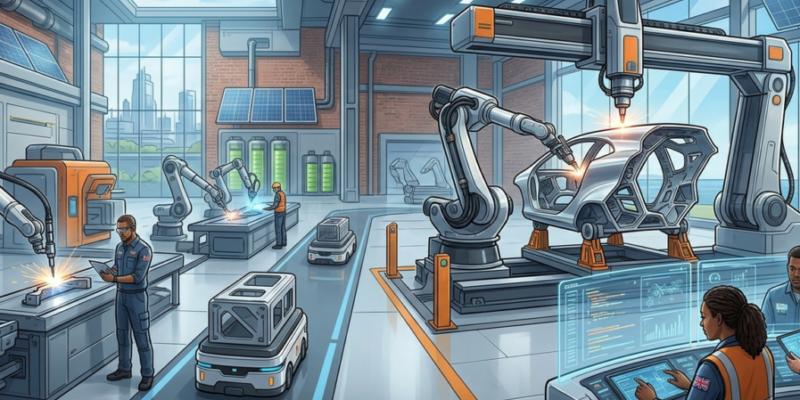
Automation is playing a major role in shaping the future of metal fabrication in the UK. Technologies such as robotic welding, automated laser cutting, and CNC-integrated systems are becoming standard across modern manufacturing environments.
The shift toward smart manufacturing enables real-time monitoring, improved repeatability, and reduced production errors. These technologies allow fabricators to increase output while maintaining consistent quality.
Industry discussions highlight how these trends are accelerating across UK fabrication businesses, with automation becoming essential to remain competitive.
At Knees Engineering, automation supports our ability to deliver precise, repeatable, and efficient manufacturing solutions.
Advances in Fabrication Technology
Technological advancement is central to the evolution of UK metal fabrication. CNC machining, laser cutting, and hybrid manufacturing methods are enabling more complex and precise components than ever before.
Modern CAD/CAM systems and automated cutting technologies are reducing material waste while improving accuracy and efficiency.
These advancements allow fabricators to achieve tighter tolerances and produce highly detailed components for demanding applications.
For Knees Engineering, adopting these technologies allows the company to remain at the forefront of precision engineering and fabrication excellence.
Sustainability in Metal Fabrication
Sustainability is becoming a key priority across the UK manufacturing sector. Fabricators are increasingly focused on reducing energy consumption, minimising waste, and improving material efficiency.
The steel industry, in particular, is moving towards electric arc furnace (EAF) production, which uses recycled steel and significantly reduces carbon emissions compared to traditional blast furnace methods.
This shift aligns with broader environmental goals and growing demand for sustainable manufacturing practices.
At Knees Engineering, the company support sustainable fabrication by optimising material usage, reducing waste, and adopting efficient production methods wherever possible.
Challenges Facing the UK Fabrication Industry
Despite strong growth potential, the UK metal fabrication industry faces several challenges.
One of the most significant is rising energy costs. High energy prices can directly impact manufacturing overheads, particularly for energy-intensive processes such as cutting and forming.
Supply chain pressures and fluctuations in raw material costs also continue to affect manufacturers, making cost control and efficiency more important than ever.
In addition, global competition requires UK fabricators to maintain high standards while delivering competitive pricing and lead times.
Skills and Workforce Development
The future of UK metal fabrication is closely linked to skills and workforce development. As manufacturing becomes more automated and technologically advanced, there is increasing demand for engineers who can operate, programme, and maintain advanced machinery.
Investment in training and upskilling is essential to ensure the industry continues to grow and adapt to new technologies.
For companies like Knees Engineering, having a highly skilled workforce is critical to delivering precision-engineered components that meet exact specifications.
The Role of Precision Engineering
Precision engineering companies play a vital role in the future of UK metal fabrication. As components become more complex and tolerances become tighter, the need for high-precision manufacturing continues to grow.
Knees Engineering, combines traditional engineering expertise with modern CNC machining and fabrication techniques to produce components to exacting standards. This integration of skill and technology positions us strongly within the evolving UK manufacturing landscape.
Final Thoughts
The future of UK metal fabrication is defined by innovation, efficiency, and adaptability. With continued growth, advancements in automation, and an increasing focus on sustainability, the industry is well-positioned for the future.