Key Takeaways:
- Compare total fabrication cost, not just quoted price, before choosing a model.
- Outsourcing often cuts costs by removing fixed overhead and unused capacity.
- Established fabricators can reduce lead times across multi-process production.
- Outsourcing lowers capital risk but makes supplier quality and reliability critical.
- A hybrid model balances in-house control with outsourced capacity and flexibility.
- In-house fabrication works best when demand is stable and equipment stays busy.

How to Choose Between Outsourced and In-House Fabrication
If you are deciding between outsourcing fabrication and doing it in-house, the answer is rarely as simple as comparing quotes. It is a total cost, lead time and risk decision, and the wrong call usually shows up at the quote stage, on the schedule or in the rework pile.
The stakes are higher than most buyers realise. Capital tied to underused machinery, operators waiting for work, or a supplier who cannot hold tolerance on a critical part: each of those outcomes costs real money. Getting this right at the procurement stage is where margins are either protected or eroded.
This guide covers cost, speed and risk across both models, with a straightforward decision rule at the end.
Outsourcing Metal Fabrication Cost: Where The Real Savings Are
The cheapest option on paper is not always the cheapest option in practice. In-house metal fabrication carries heavy fixed costs: machinery, maintenance, software licences, operators, training, compliance and spare capacity when demand dips. If your shop floor is running at 60% utilisation, you are paying 100% of the overhead.
Outsourcing turns more of that into variable cost. You pay for the job, not the entire production setup, which is why subcontract fabrication services often win for low-to-medium volumes, project work and unstable demand.
A good procurement comparison is not piece price versus labour rate. It is total landed cost. The table below shows where each model typically wins and loses across the factors that matter most to commercial buyers.
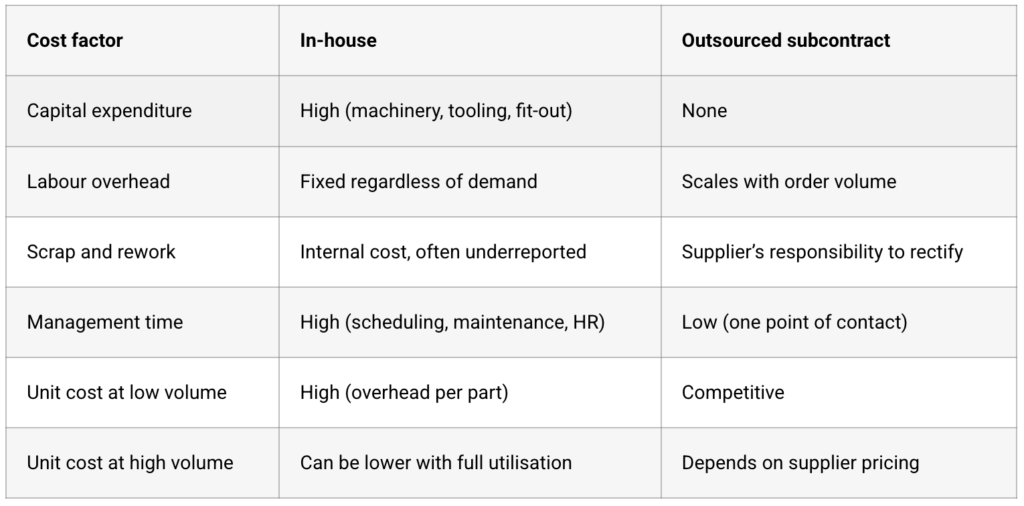
Compare total fabrication cost using:
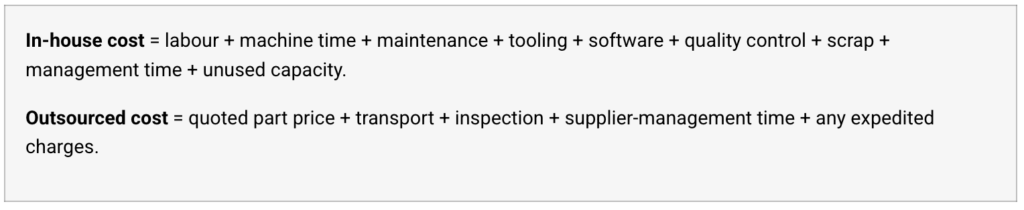
If the in-house equipment will not remain heavily utilised across the year, outsourcing is usually the stronger commercial case.
Fabrication Services Speed: Who Gets Parts Out the Door Faster
If you need parts quickly, outsourcing usually wins at the start. An established subcontract fabrication partner already has the machines, operators and process flow in place, so you skip the setup phase entirely.
That matters most when the requirement spans multiple processes: fibre laser cutting, CNC folding, welding and surface finishing. A supplier with all of those capabilities under one roof runs the job end to end without you building each process from scratch or managing a chain of subcontractors yourself.
For example, FC Laser operates more than 1,900 hours of weekly production capacity, with four 12 kW fibre lasers, automated loading and unloading, and 24/7 laser cutting and CNC folding. By managing cutting, folding, welding, powder coating, assembly and fulfilment in one operation, FC Laser reduces the handovers that can delay multi-process fabrication programmes. Its Salvagnini P2 panel-bending technology also enables up to 17 bends per minute without manual re-tooling, helping to reduce forming setup time for suitable parts.
A single supplier with end-to-end fabrication services collapses that coordination into one call, one purchase order and one delivery. Modern automated sheet metal bending technology has also significantly shortened forming lead times, which means the bottleneck that used to sit in the folding bay is increasingly removed from the equation.
In-house only gets faster once the process is mature. If the part is repetitive, the tooling is proven and the team is fully embedded, internal production can beat an external supplier on turnaround.
Why Outsourcing Often Wins on Speed and Simplicity
For commercial buyers, the practical question is not “who is fastest forever?” It is “who can hit the first deadline with the least disruption?” In most cases, that points to outsourcing. This is especially true when your work spans sheet metal fabrication, steel fabrication and finishing processes like powder coating, because each extra process step adds coordination time when managed internally.
Metal Fabrication Risk: Where Outsourcing Helps and Where It Hurts
Risk is where the decision gets more nuanced and where most procurement guides oversimplify.