In the high-performance world of aerospace turbine manufacturing, agility and precision are mission-critical. Traditional fabrication methods—casting, forging, and subtractive machining—struggle to keep up with demands for faster development cycles, complex geometries, and cost-efficiency.
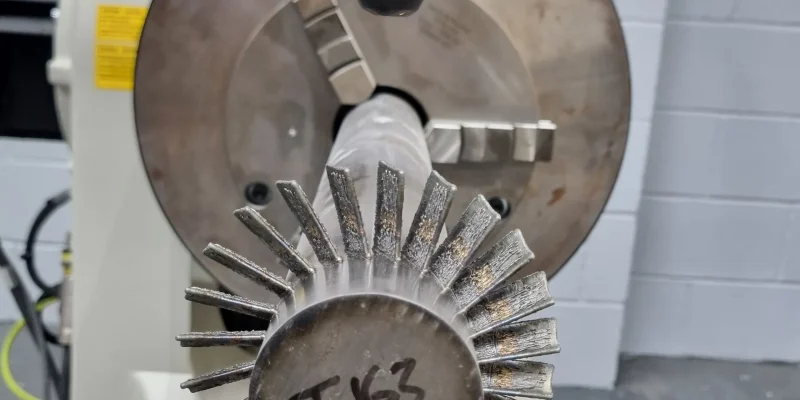
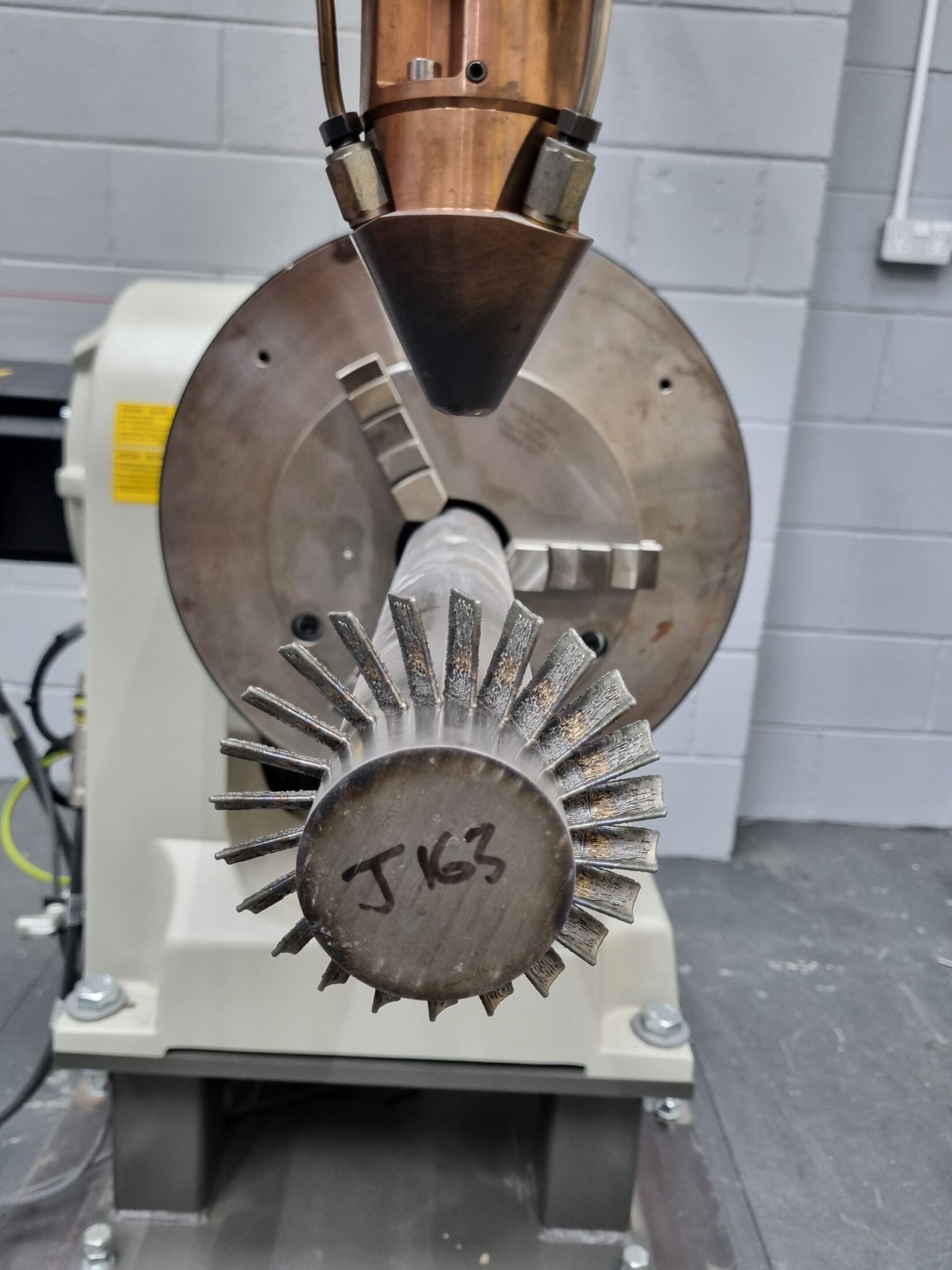
Enter Laser Directed Energy Deposition (L-DED): a form of metal additive manufacturing that offers unprecedented design flexibility, reduced lead times, and near-net shape efficiency. We are demonstrating this capability through a novel process for manufacturing Inconel 718 turbine blades, optimized for jet engine applications.
What is Laser Directed Energy Deposition?
L-DED is an advanced metal 3D printing technique where a laser and metal feedstock (typically powder or wire) are combined to deposit material precisely, layer by layer. Our system features:
- A TruDisk 3001 laser delivering stable energy input
- A 6-axis KUKA industrial robot enabling complex multi-orientation deposition
- Full CAD-to-CAM integration for seamless digital manufacturing
- Inconel 718 feedstock for high-temperature, aerospace-grade performance
This combination allows for L-DED of turbine blades starting from a 60 mm bar stock, building up to 110 mm diameter blades with tight control over geometry and structure.
Key Benefits for Turbomachinery
For aerospace OEMs, defence contractors, and propulsion system developers, L-DED offers several transformative advantages:
– Reduced Lead Times
Eliminate long waits for forged blanks or castings—go from design to finished component in days.
– Tooling-Free Flexibility
No custom moulds, dies, or fixtures are needed—perfect for rapid prototyping, short-run production, or scalable high volume production.
– Material Efficiency
Inconel 718 is expensive. Our L-DED process minimizes waste and maximizes deposition yield with conversion efficiency reaching up to 90% with powder.
– Rapid Design Iteration
Integrated CAD/CAM workflows allow immediate implementation of design changes, ideal for R&D or performance optimization.
– Automated, Scalable Process
Robotic deposition ensures consistent, high-quality builds with minimal operator intervention—laying the groundwork for future production scaling.
Applications in Aerospace and Defence
Our current demonstration targets jet turbine blade manufacturing, with potential applications across:
- Aerospace propulsion systems
- Military turbine engines
- Industrial gas turbines
- UAV and next-gen propulsion platforms
This capability is especially relevant for UK defence programs, where agility, local supply chain resilience, and advanced manufacturing innovation are strategic imperatives.