Choosing between mild steel and stainless steel is not a question of which material is better. The right choice depends on where the component will be used, its operating environment, the finish required and the project budget.
Mild steel is widely used for general engineering because it is practical and usually has a lower material cost. Stainless steel is often the better choice where the specification calls for corrosion resistance, regular exposure to moisture or an uncoated metal finish.
Selecting the right material at the design stage helps avoid paying for properties the component does not need or specifying a material that is unsuitable for its working environment.

Mild Steel vs Stainless Steel at a Glance
Both mild steel and stainless steel, are well suited to fibre laser cutting, but each material suits different requirements.
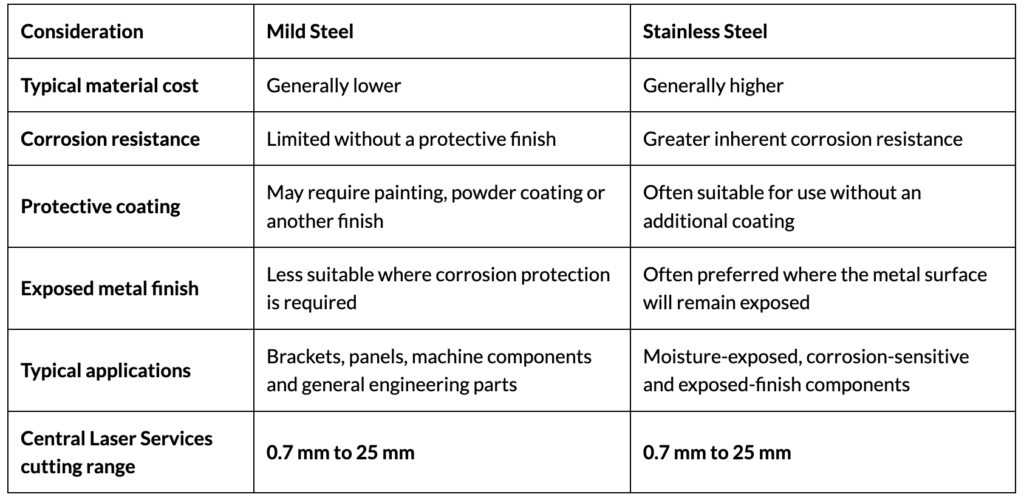
The material should be selected according to the component specification, working environment and required finish rather than purchase price alone.
When Does Mild Steel Make Sense?
Mild steel is a practical choice for a wide range of manufacturing and general engineering components.
For brackets, panels, machine components and other profiles used indoors or in controlled environments, the additional corrosion resistance provided by stainless steel may offer little practical benefit.
It can also be a commercially sensible option where the finished component will be painted, powder coated or given another suitable protective finish.
Material cost becomes increasingly important as quantities rise. Specifying stainless steel when its additional properties are unnecessary can increase project cost without improving the performance of the finished component.
When Should You Choose Stainless Steel?
Stainless steel may be the more appropriate choice when corrosion resistance is an important part of the specification.
The chromium in stainless steel allows a thin, passive oxide layer to form naturally on the surface, providing greater inherent corrosion resistance than unprotected mild steel.
This makes stainless steel suitable for many components exposed to moisture, particularly where applying or maintaining a protective coating would be undesirable.
Stainless steel is not corrosion-proof. The grade selected and the conditions in which the component will operate still matter, especially in demanding environments.
Where an exposed metal surface forms part of the finished component, stainless steel can also provide the required appearance without applying a coating purely for corrosion protection.
Does Material Choice Affect Laser Cutting?
Yes. Mild steel and stainless steel can both be processed accurately using fibre laser cutting, but the cutting parameters must suit the material and thickness.
Laser power, cutting speed, focus position and assist gas can all affect cutting performance and edge quality.
From the customer’s perspective, the important thing is to provide a clear specification from the outset. Supplying a suitable 2D CAD file together with the required material, thickness and quantity gives the team the information needed to assess the job correctly.
Which Steel Is More Cost-Effective?
Mild steel generally has the lower initial material cost, but price alone should not determine the specification.
If mild steel requires painting, powder coating or another protective finish, that additional processing contributes to the finished cost.
Equally, paying more for stainless steel may provide little benefit where the component will operate in a dry, protected environment and mild steel already meets the engineering requirements.
Consider:
- Operating environment
- Material grade and thickness
- Quantity
- Corrosion requirements
- Finishing requirements
- Required service life
- Engineering specification
The best choice is the material that provides the required performance at the most sensible overall cost.
Five Questions to Ask Before Choosing
Before specifying material for a laser-cut component, ask:
1. Where will the component be used?
For many components in dry, controlled indoor environments, mild steel may be suitable. Regular exposure to moisture may make an appropriate stainless steel grade the better choice.
2. How important is corrosion resistance?
If inherent corrosion resistance is required, an appropriate stainless steel grade may be the better starting point.
3. Will the component be coated?
If it will be painted, powder coated or otherwise protected, mild steel may provide the required performance at a lower material cost.
4. Will the metal surface remain exposed?
Where appearance and an exposed metal finish matter, stainless steel may be more appropriate.
5. What does the engineering specification require?
The drawing and performance requirements should determine the material. Cost matters, but not at the expense of component suitability.