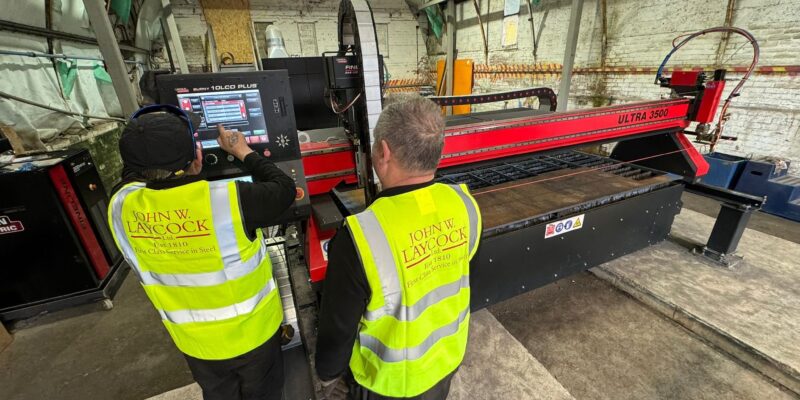
When JW Laycock first brought plate profiling in-house, the machine it chose failed to live up to expectation — but the long-established steel stockholder has since put that experience firmly behind it, investing in a Kerf Developments Ultra 3500. The combination plasma and oxy-fuel cutting machine from Kerf has slashed the firm’s profiling lead times from weeks to days, and even to hours where necessary. More importantly, it has given the company complete control over a process it previously subcontracted.
JW Laycock started making nails in Keighley in the 1740s, and when the Laycock family line ended after the First World War, it passed to the Sugden family – a dynasty in its fourth generation at the helm. More than 280 years of trading have built a reputation for first-class steel services and a propensity to evolve with technology. This evolution has moved JW Laycock from producing nails to a traditional steel stockholder and now to a complete service provider.
“We’re adding more services, so we can provide the complete package,” explains Managing Director Mark Sugden. Bigger saws, angle-cutting, guillotining and drilling were all brought in-house — leaving profiling as the last piece of the jigsaw.
For a business built on responsiveness, that gap mattered. JW Laycock could cut structural steel and section with immediacy, but profile plates had to be subcontracted — which meant waiting, typically four or five working days. “Our business is very much built on being reactive. If a customer says, ‘I need something literally now,’ we’d do it — with any type of steel. But we couldn’t do it with profiles,” says Sugden. Profiles accounted for only about 5% of sales, yet they routinely held up the whole package. “For example, we could have a 10-tonne order with multiple parts, and we could supply 9.7 tonnes immediately, but there would be a few parts that needed profiling. This meant relying on a subcontractor and, subsequently, a lead-time delay.
The Solution
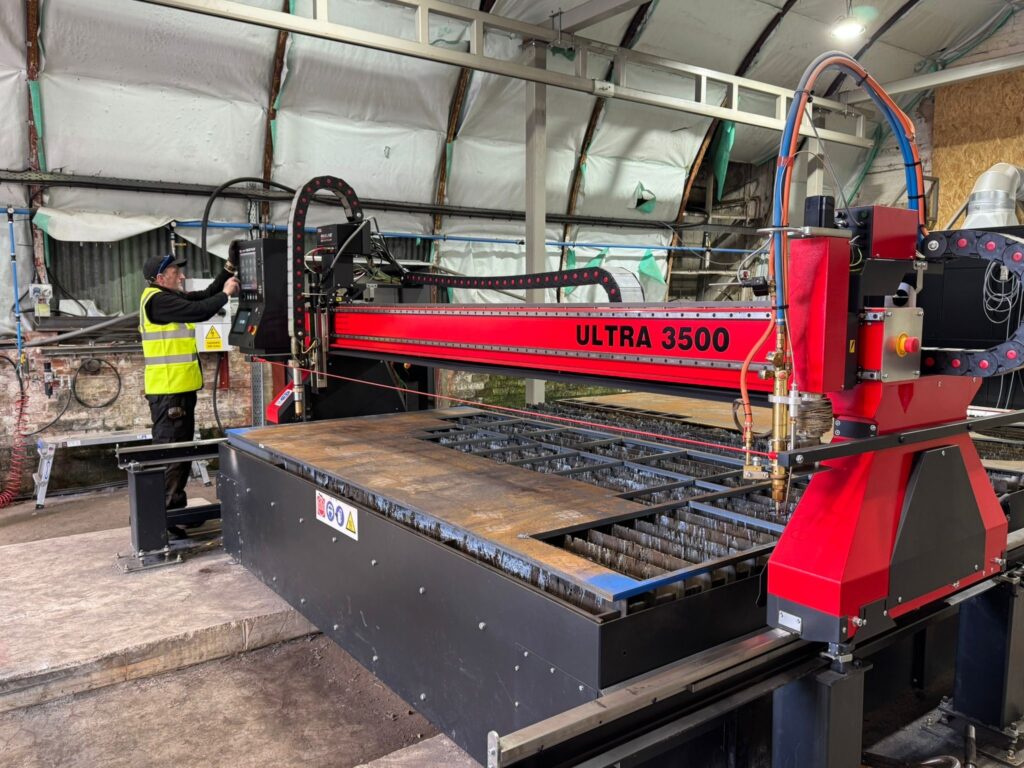
Discussing the business requirements, it was agreed that the right solution was the Kerf Ultra 3500. Configured as a combination system with a generous 3 by 4m bed, carrying both plasma and oxy fuel cutting heads, JW Laycock could select the optimum cutting process for every job. The vast majority of JW Laycock’s work falls between 8 and 30mm thickness, cutting sheet steel plate, tread plate, boiler plate, stainless and structural grades including S275 and S355, where the plasma head delivers the speed and edge quality modern fabrication demands. Beyond the recommended plasma cutting thickness of around 40mm, the oxy-fuel head handles thicker sections up to 150mm.
The Ultra 3500 is built around an ultrasonically stress-relieved frame for long-term rigidity, while digitally synchronised drives, coupled to planetary gearboxes, power twin side rack-and-pinion systems on both axes, delivering smooth, repeatable, and precise motion across the full working envelope. Machine control is provided by the Burny CNC, a controller developed specifically for profile cutting. Its touchscreen interface provides operators with an on-board shape library and an extensive process database that automatically sets the correct gas pressures, cutting speed, height adjustment, and pierce parameters for the material and thickness, taking the guesswork out of set-up. This ensures fast, repeatable results regardless of who is running the machine. Automatic torch height control maintains the optimum height throughout the cut, regardless of variations in plate flatness. Program nesting is also automated to help JW Laycock reduce material waste and cost.
Using Lincoln Electric’s FineLine 300 Ultrasharp technology, the Ultra 3500 delivers precise, high-definition 300-amp cutting. The patented plasma torch and consumables enable consistent cutting that uses up to 54% less plasma gas than competing technology. With the magnum pro LC300M torch, the smallest-diameter high-definition 300A plasma torch in the industry, secondary processing is minimised, precision and cut quality are improved, and bevel cutting capabilities are maximised. Commenting on this, Sugden adds: “It’s absolutely superb. It cuts like a hot knife through butter.”
The Support
Following a disappointing experience with a previous supplier, Kerf Developments completely reset the customer experience. The Ultra 3500 was installed in December 2025, smoothly and on time, with operator training completed the following month. “With the previous machine, I had to know everything about it because I was constantly going into battle to get help and deal with breakdowns. The Kerf experience has been seamless. I have handed responsibility to my team, and they have just got on with it. One of the biggest compliments in the context of our situation is that I know very little about the Kerf machine – because it works, we trust Kerf, and the shop floor guys love it.
The Benefits
The benefits are evident across the business, but the most striking is the transformation in lead times. Profiling that customers once waited four or five days for can now be turned around in hours with confidence – this is winning an abundance of new business from both new and existing customers. The nesting software is delivering material savings of at least 10%. The machine typically runs around 10 hours a day on a single shift, and Sugden expects the Kerf Ultra to pay for itself within 12 months. Consumables and spares are all UK-sourced from Kerf, removing delays caused by parts from overseas. Furthermore, at roughly half the footprint of its predecessor, the Ultra machine has freed up valuable floor space.
Above all, the Ultra 3500 has restored confidence. With reliable profiling underpinning the company’s growth ambitions, JW Laycock has won back customers who had gone elsewhere and now sells its profiling service with conviction. “The Kerf machine is trouble-free and value for money, and that’s exactly what we want. We’ve got confidence in the machine, in Kerf as an organisation, and the Kerf team. It allows us to sell with much more confidence.” That growth shows in the numbers, with turnover expected to leap from just over £2m last year to around £3.5m this year. The Kerf Ultra is contributing to this step change. It has given the company renewed confidence to profile in-house, on demand and without compromise.
With growth accelerating, Sugden can already see scope for further Kerf machines. For a business that has endured for more than two and a half centuries by evolving with the marketplace, the Kerf Ultra 3500 is exactly the kind of investment it needed: the right machine, from the right supplier, with the right support behind it.