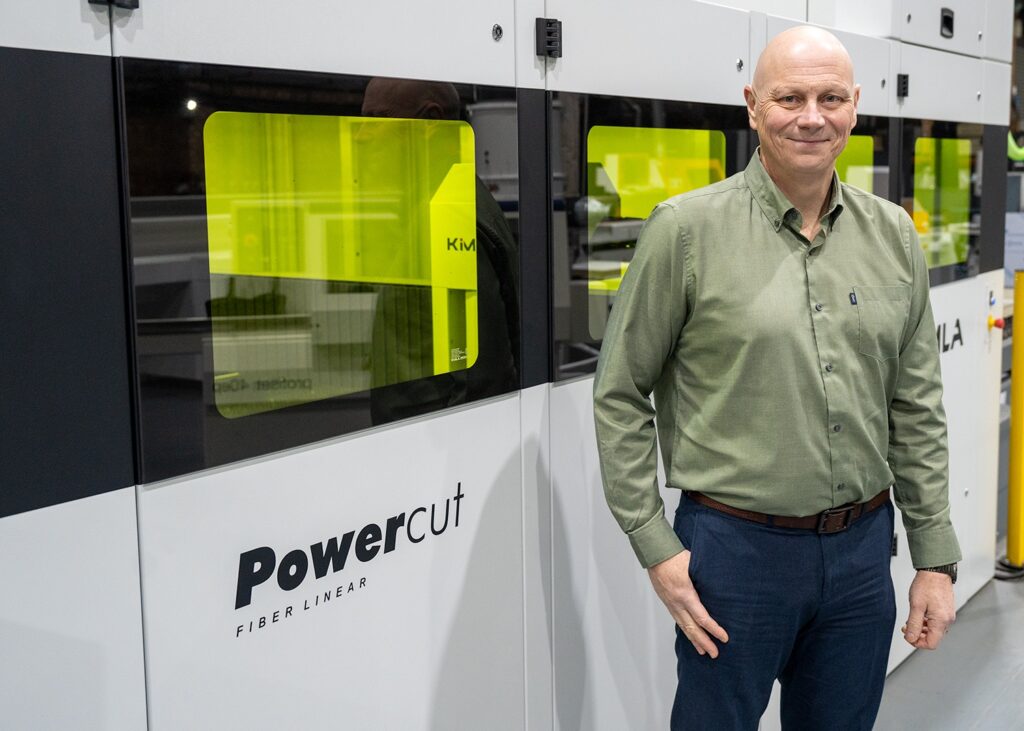
Thank you to Adrian Wright, Fiber Laser Specialist at Daltons Wadkin, for his views representing a leading UK multi-material machine solution supplier
Much earlier in my career, I worked for an international advanced machine-solution provider that built a pretty neat piece of kit.
It sat as part of a whole sheet-unloading system, utilising suction cups. I can only describe it, even today, as being like a giant octopus, with huge tentacles that acted as suckers, grabbing different parts and placing them on pallets.
As I said, it was a pretty neat innovation at the time. But it was scrapped almost as quickly as it started. Why? Because despite its theoretical promise, the system faced significant challenges in real-world applications. The ideal conditions assumed during development did not hold in practice, leading to numerous operational headaches.
Fast forward to today, and that innovation in automation still sticks out to me as an illustration of the difficulties of implementing solutions in a practical manufacturing environment.
But here’s the truth — and it’s not particularly glamorous — I haven’t seen something that has captured my imagination since that failed machine.
Automation is just a means of loading and unloading sheets without manpower, scaled to what the customer can afford and with how many shelves. Manpower is still there at some point. There may be machines on the market dedicated to removing parts, but there is still another cost centre waiting in the wings to take this to the next location or operation.
And for all the glossy marketing campaigns and headline-grabbing buzzwords, the core of our industry hasn’t changed all that much in two decades.
It’s ironic to say that, considering the period in time we’re operating in, because if you believed everything you read, you’d think we’re living through a golden age of innovation in manufacturing. Automation is “revolutionising” production, AI is “transforming” processes, and the latest generation of machine tools is supposedly “game-changing.”
However, in the sheet-metal and machinery world, what we’ve really seen is incremental improvement, not innovation. Fibre-laser cutting, for instance, reduced operating costs and made systems leaner and greener. Electric punching machines replaced hydraulic systems. Press brakes became a mix of hybrid and full electric. But all three of these machine tool types, in essence, just became leaner and greener and more efficient.
Margins have improved for machine owners, yes, but the broader impact on productivity, integration, and customer outcomes? That needle has barely moved.
The illusion of progress
Every major manufacturer claims to be leading the charge in innovation. They’ll showcase a new feature, a software enhancement, a marginal speed increase. But within 18 months, their competitors catch up, and we’re back to square one. It is a race of incremental gains disguised as breakthrough progress.
We’ve fallen into a loop: each OEM tweaks its machine to be slightly faster, slightly more efficient, slightly more automated. But the fundamental process, and the challenges that come with it, remain unchanged.
In truth, innovation has become a marketing term, not a mechanical one.
We’re experiencing automation evolution
Automation is often touted as the next frontier, but the reality on the shop floor tells a different story. The majority of customers I speak to arenot looking at fully automated systems. In fact, many subcontracting laser-cutting companies still load and unload manually. Not because they don’t want to automate, but because the economics rarely stack up.
If you’re producing high-volume, repeat work, automation can make perfect sense. But for bespoke, varied production environments, the return on investment often isn’t there. Most manufacturers buy machines to solve an immediate problem, not to overhaul their operation. They want something better, not necessarily different. That’s a mindset that keeps us standing still.
Even where automation is adopted, it’s often surface-level — loading systems, sheet towers, or part-marking integrations — not end-to-end digital transformation. True automation should be about connecting systems, not just machines. Yet the integration piece is what’s consistently missing.
The next step in innovation lies in solving the machine integration gap
This is where the industry’s stagnation becomes most apparent. The focus has been on building better machines, not better systems. Manufacturers remain largely siloed, with each brand perfecting its own technology without considering how it connects downstream.
In theory, the path forward is clear: interoperability, data-driven manufacturing, and smarter scheduling powered by AI. Imagine simply inputting what you want to make — dimensions, material — and the system generating the programme automatically, allocating it to the right machine, and managing flow through to finishing.
That’s not science fiction. The computing power exists today. Consider this: only 9% of firms surveyed in the UK advanced manufacturing sector reported adopting AI in 2023, despite broader technology investment. Office for National Statistics. Make UK’s Executive Survey 2025 corroborates this, finding that just 29 % of manufacturers planned to invest in cloud or AI technologies during 2025, versus far higher proportions in finance or retail .
The UK manufacturing and sheet metal sectors are strong in engineering capability but weak in system‑level, digital, and commercially applied innovation, constrained more by finance, coordination, and culture than by technology itself.
Our industry has been slow to adopt integration-first thinking because it requires collaboration between manufacturers and, frankly, that’s not how we’re wired.
Everyone, you’d argue naturally, wants to protect their own IP, their own ecosystem. But until we break down those barriers, we’ll keep circling the same problems.
Is real innovation just a utopia or a real opportunity?
It’s obvious that AI will almost certainly be the next evolution in machine tools, not in the physical machinery itself, but in how jobs are programmed and scheduled.
The ability to auto-generate cutting paths, optimise machine usage, and adjust scheduling dynamically could redefine efficiency. Meanwhile, technologies that improve traceability, such as part-marking systems that add barcodes or QR codes directly to components, offer immediate, real-world benefits. One customer described to me that feature alone as a “light-bulb moment.” It wasn’t new technology, but applied to their process, it solved a real, costly problem.
That’s what innovation should look like. Not reinvention for its own sake, but smarter application of what already exists.
But it’s going to take the industry to be braver and be willing to take a chance.
If we want to move beyond stagnation, it’s going to take more than small steps. It will take companies willing to be bold, to experiment, to break, to fail, and to rethink what’s possible when systems — not just machines — are connected.
The reality is that our industry is still heavily reliant on human interaction. That’s not necessarily a bad thing, but it does limit scalability, consistency, and speed. AI-driven programming and smarter integration could help bridge that gap, reducing dependency on skill shortages and opening up new levels of productivity.
But someone has to go first. It’s going to take a manufacturer, or even a customer, willing to invest. And not just in a machine, but in a mindset shift.
Conclusion… It’s time to break the cycle
I will end with how I started, reflecting on the build of that giant octopus full of suction cups more than twenty years ago. It didn’t meet real-world needs. It failed. But the desire to break new ground and try something different should be applauded. At its heart, isn’t that what innovation is all about?
After decades in this industry, I can say with confidence that manufacturing is full of incredibly talented people working with incredible technology. But we’ve become conditioned to accept slow, safe progress. It’s all much of the same.
The next real innovation won’t be about incremental gains. It will be about thinking differently. Connecting different machines from different manufacturers. Connecting data. Connecting people. Customer-driven AI orders with little or no human intervention. The scope of our industry is vast.
Until that happens, we’ll keep calling evolution “innovation” and wondering why it all still feels the same.