Steel bending is a core process in many industries, from construction and infrastructure to engineering and manufacturing. However, not all bending processes are the same, and choosing the right method is crucial for strength and suitability. Angle Ring has over 75 years of experience in delivering high-quality steel bending services in the UK. We take pride in offering our skills, experience and knowledge to architects, fabricators and engineers for projects of all shapes and sizes.
Angle Ring breaks down how each technique works, the advantages and limitations of each, and how material types, such as cold-rolled vs hot-rolled steel, affect bending.
What Is Steel Bending?
To start at the very beginning, steel bending is the process of shaping metal into curves or angles without breaking it. Most commonly, the two methods that can be used in this process are cold bending, which is performed at or near room temperature, and hot or induction bending, where the steel is locally heated during the bending process.
The debate over the best method or key differences in hot bending vs cold bending comes from how temperature changes the metal’s behaviour and structure during the forming process, the comparative levels of deformation between the two methods, and the cost implications
What Is Cold Bending?
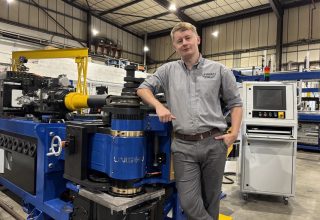
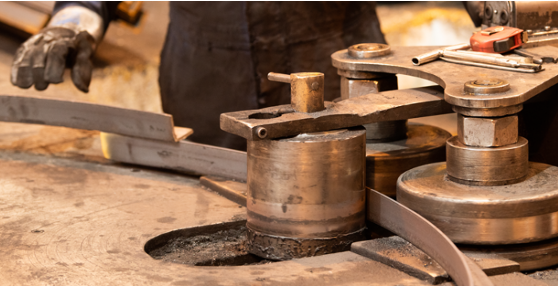
Cold bending is the process of shaping steel without heating it, relying purely on mechanical force to achieve the desired curvature or shape. This method is commonly performed using specialised machines such as roll benders, presses, rotary draw benders, plate rolls, plate roll-formers, and press brakes.
Because the material is bent at room temperature, the process can introduce work hardening, which in extreme cases may change material properties. This method of cold bending is typically used for:
Structural steel sections & plates, Tubes and pipes with moderate bend radius, or tube manipulation with tight radii. Sheet metal components & High-volume fabrication projects.
Advantages and Limitations of Cold Bending
Cold bending is widely used across manufacturing because of several key benefits:
- Smooth surface finish with minimal oxidation
- Faster production speeds since heating and cooling are not required
- Lower operational costs due to simpler processing and reduced energy consumption, compared to hot bending
On the other hand, there are some limitations of cold bending in some situations. For example, cold bending may not be suitable when:
- The steel is particularly thick or high-strength in relation to the section size and required radius
- The result required a particularly tight radius, where tube manipulation is not suitable
- When bending excessively, the stress on the metal could cause cracking in certain material grades/section shape or size.
For these projects, hot bending may be a more appropriate choice.

What Is Hot Bending?
Hot, or induction bending, involves heating a narrow band of the section to high temperatures during the bending process, then quenching with water. Heating softens the material, allowing it to be formed with less deformation in comparison to a cold-bending technique. Quenching can increase material hardness. The process tends to allow you to achieve tighter bends without fracturing or introducing excessive stress, which may lead to distortion of the section.
Because of this, hot bending is typically used when working with large structural components, heavy steel sections, pipelines and industrial tubing, or complex structural curves. There is no direct tooling contact in the bend area when hot forming, which can lead to section shapes being ‘squashed’ during certain cold bending processes.
Advantages and Limitations of Hot Bending
When comparing hot bending vs cold bending, hot bending offers several advantages for demanding applications that cannot be achieved with cold bending. Advantages of hot bending methods include:
- Allows a smaller bend radius with minimal deformation
- Suitable for thicker and stronger materials.
- Reduces the risk of cracking or heavy surface marking during forming
. - Minimises internal stresses in the material.
Despite these benefits, hot bending does has disadvantages. Extra ‘scrap’ is required due to the machinery size and geometry. Material must be clean and free of any coatings before processing (varnished line pipe, for example). Heating then quenching the steel can introduce oxidation and discolouration, which may require additional finishing processes such as pickling or passivation.
Material also requires mechanical testing after bending, to ensure its properties are in line with original material specification. If hot/induction bending changes material properties, then heat treatment may be required to ‘change back’ any changes introduced during the bending process. This can add cost/time.
Some materials are more likely to require heat treatment than others. Please speak to the team to find out more.
How to Choose the Right Method
Selecting between hot bending and cold bending depends on several factors, including the level of precision you require, material thickness, lead time, project budget, bending specification, and complexity of the bends required. Understanding the differences between the cold-rolled vs hot/induction forming ensures the final product meets both structural and project requirements.
You could choose cold-bending methods when:
- Short lead times are required
- The end application has no specific wall thinning requirements
- The material strength/size fits within the cold-bending machinery limits
- Cost efficiency and speed are priorities

Alternatively, you could choose a hot/induction bending method if:
- Very small radii in relation to the section size/thickness are required
- Minimal sectional deformation is important for the final application
- Large structural components fall outside the scope of cold-bending methods due to material strength
- Unusual shapes where cold-bending tooling is not suitable or available