One of the largest independent designers and manufacturers of workspace furniture in the UK, Gresham Office Furniture operates from a 200,000 sq ft factory on a 14-acre site in Bolton, where in early 2025 three more machines were installed from BLM Group UK, a subsidiary of the Italian tube and sheet metalworking machine manufacturer.
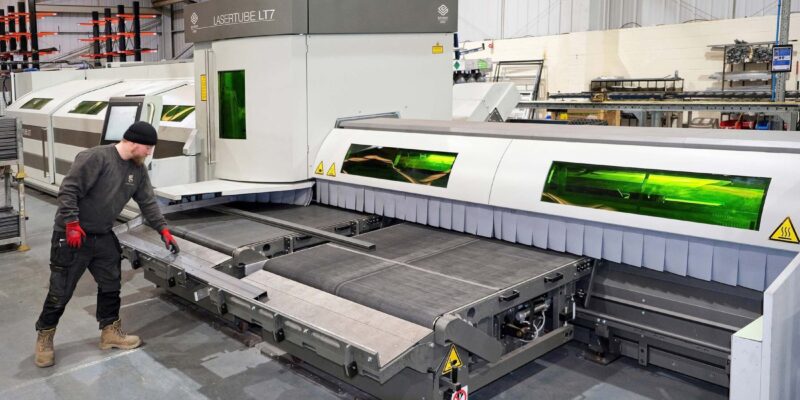
The equipment supplied comprises a tube laser cutting machine, which joined a BLM tube bender installed seven years earlier, a flat-bed fibre laser cutting machine and an electric press brake. It would be difficult to overstate how empowering the successful completion of this project has been for Gresham, as it has allowed all metal furniture component manufacture to be brought in-house, whereas previously two-thirds was outsourced to subcontractors.
David Openshaw, Operations Manager at the factory, commented, “The BLM acquisitions were part of a £7 million investment last year that also included a new enterprise resource planning system and a Homag line for processing wood-based panels, which accounted for nearly two-thirds of the spend.
“Insourcing all of our metal component manufacture has been a major benefit, as Brexit, swiftly followed by Covid and then the start of the Ukraine war all played into a lengthening of lead-times from our subcontractors.
“Gresham prides itself on quick deliveries to customers in 10 to 15 days from receipt of order, so we wanted total control over the supply of all office furniture components. Our latest investments have delivered exactly that.”
The production team in Bolton was keen that all sheet and tube working machines on the shop floor should be from the same supplier, as modern manufacturing demands a high level of digital integration. It is particularly important that the tube bender can feed back data to the tube laser.
Even though the existing electric tube bender was supplied by BLM, Gresham evaluated two other potential sources for the planned extra machines. The incumbent supplier was chosen due to the successful pre-existing working relationship, which originally dated back to 2001 with the arrival of a hydraulic BLM tube bender, which notably is still in operation today.
Tube Laser Cutting and Bending
Tube processing is a perfect example of how important it is that production machines are able to exchange data. If a bolt hole is to be cut on the BLM LT7 Lasertube for bending on the E-TURN 52, the machine supplier’s ArTube 3D CAD/CAM software predicts how much the tube will stretch during the bend and automatically tells the laser cutter to position the hole the relevant distance away from its nominal position. This adjustment is different for the five dozen or so different mild steel and aluminium tube cross sections in stock at the Gresham factory (round, square or open-section), for each wall thickness, which varies from 1.2 to 2.0 mm, and for every bend angle.
If the E-TURN 52’s axis motor torque sensors and internal laser measurement detect that the metal is stretching more or less than ArTube predicted, causing the hole to be slightly out of position, a correction is sent to the LT7 control to update the program before the next length of tube is cut. Inaccuracy in the bend angle due to springback is similarly measured and compensated, in this case immediately by the E-TURN 52 on the very part that is being processed, rather than the next one. VGPNext is the BLM software executing programming of the bending machine and 3D simulation for collision checking.
Mr Openshaw added, “Inter-machine communication avoids problems caused by inconsistency in tube material supplied to us, which can vary in wall thickness by 0.2 to 0.3 mm. It does not sound much, but it has a big effect on the bend. In-process adjustments are essential to ensure right-first-time production at the start of a batch and to prevent scrapped parts.”
He pointed out a couple of other highlights of the LT7 tube laser that promote productivity. One is in-process stud rivet insertion, which is believed to be a first in the UK. Another useful feature is the ability to scan the end of a tube and accurately manipulate it to laser-cut joints optimally for better weld positioning and penetration, either by robot or by hand. The laser’s 3D tilt-head sculps tube ends to sub-millimetre accuracy, not only creating a stronger and more aesthetic join, but also minimising the amount of filler wire used and eliminating the need for subsequent fettling.
Sheet laser cutting and bending
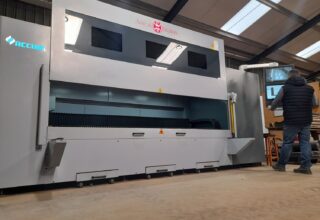
The BLM LS7 3015 flat-bed laser profiling machine powered by a 6 kW fibre laser and the STR Verde 260-100 press brake are able to optimise their own performance. Third-party software is in use for these machines: Lantek CAD/CAM nests 2D components efficiently into each mild steel sheet to maximise material yield; and EsaBend 3D programming and control software oversees press brake operation. It is, however, BLM’s overarching Prometheus master software that coordinates work orders across all of the machines the BLM Group has supplied.
The fibre laser flat-bed cutting system is engineered for speed, having simultaneous axis acceleration of 2g and a high-speed, electrically-operated pallet changer that swaps sheets in just nine seconds, all designed to maximise production output. The machine incorporates an aluminium gantry on a polymer-concrete base to ensure high rigidity and vibration damping, even during rapid changes of direction of the laser head. The machine is further enhanced by BLM’s Active Tools, which automatically adapt the laser beam diameter and cutting parameters to maintain a burr-free finish.
Mr Openshaw is particularly impressed by the time-saving nozzle changing system that reduces setup time when switching between different material thicknesses. Featuring an automated, 18-position magazine, the system can swap a nozzle in seconds, ensuring the machine always uses the optimal geometry for the specific laser power and gas pressure required for the job. Nozzle wear monitoring uses a camera to inspect nozzle condition and automatically initiates a replacement if it detects degradation that could compromise the quality of cut.
The standout feature of the BLM STR Verde 2.6 metre / 100 tonne press brake is the LED-guided tool position indicator. Instead of measuring or estimating where to place punches and dies, a strip of LED lights along the upper beam illuminates the exact location that each tool should ideally be placed. It not only reduces setup times, but also acts as a guide during the actual bending process, highlighting where the operator should place the workpiece for each sequential bending operation. Complex parts with multiple bends are handled correctly every time, without the risk of human error.
To guarantee accuracy from the very first piece, the press brake uses an infrared laser to measure the bend angle. As the machine initiates a bend, high-speed sensors detect the interior angle of the profile in real-time. If the material exhibits any springback or variation in thickness, the system triggers an automatic bend correction, dynamically adjusting the ram depth mid-cycle to hit the exact programmed angle. Once a perfect result is achieved, a program-save function allows the optimised parameters to be stored in the machine’s library.
As STR has integrated EsaBend 3D software into the press brake control, it is an easy matter for the operator to transfer a STEP file of the component to be bent, derived from a 3D solid model in Gresham’s Autodesk Inventor CAD/CAM system. The control software unfolds the STEP file, identifies the specific tooling available in the shop, applies any crowning and springback adjustments that are typical for the material to be bent, and generates the G-code. This handshake between Inventor and the press brake ensures that the first part off the machine is accurate, as are all those subsequently produced.
Conclusion
With more than 600 part numbers in its system, Gresham’s manufacturing operation is complex and material usage is high. Bringing production in-house has ensured more efficient use of sheet metal, as intelligent nesting of components minimises material wastage, while tube stock utilisation is also maximised.
Mr Openshaw concluded, “The whole of every sheet processed in-house is now turned into components, which was not possible when some orders for a limited number of brackets and small parts were formerly placed with a subcontractor.
“Likewise, with laser-cut tubular parts that were previously bought in, the BLM LT7 is able to process an entire length of stock and subsequently reuse any off-cuts, eliminating the inevitable scrap at a subcontractor when an ordered batch had been run off.
“Whether it was sheet or tube parts that were being produced externally, the unused material was of course charged to us, which raised the cost per part. That is now a thing of the past.”
He added that the Bolton factory operates a 40-hour week, Monday to Friday, so there is plenty of potential for raising production output as future needs dictate, especially as the flat-bed laser’s capacity is less than half utilised at present. Even the busiest machine, the tube laser, currently needs to run for only three-quarters of the time.
The business case for integrating production entirely in-house is validated by Mr Openshaw’s reflection on the company’s evolution. Twenty-five years ago when he joined Gresham, annual turnover was £18 million and there were 300 staff on the shop floor. Today there are one-third the number of machine operators and assembly personnel and turnover has doubled.