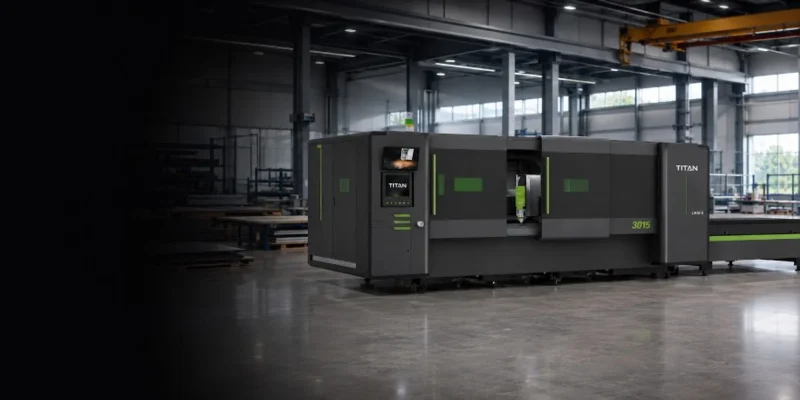
Fibre laser and CNC plasma both cut sheet metal for UK fabrication shops — but they are not the same process, and they do not produce the same edge, nest density or finish cost. Plasma remains a practical route for thick mild steel and rough prep. Fibre laser has become the default when stainless, aluminium, tighter tolerances and cleaner edges drive your quoting. This guide helps UK buyers decide which route fits everyday work — and when a shop still needs both.
Plasma still earns its keep on thick mild steel plate — fibre wins when stainless, aluminium and clean sheet edges drive your quotes. Compare Vector and Titan on the fibre laser hub, match kW on the power guide, and model ownership on the fibre ROI calculator before you retire or keep your plasma cell.
The short answer: start with thickness, material and finish
- Everyday thin-to-mid sheet — mild steel, stainless and aluminium with clean edges and accurate nests — usually points toward fibre laser.
- Thick plate, structural sections and rough blanks where kerf and heat-affected zone are acceptable often still suit CNC plasma.
- If you cut both thin precision sheet and heavy plate, many workshops run plasma and fibre as complementary cells — not one machine for every job.
- CO₂ laser and CNC routing answer different materials entirely — use the sibling comparison guides when acrylic, timber or routed board dominate.
How the two processes differ
CNC plasma cutting uses an electrically conductive gas jet — plasma — to melt and blow metal from the cut path. It is robust, relatively forgiving on thicker mild steel, and familiar on many UK fab floors. The trade-offs are a wider kerf, more heat-affected material, and edges that often need secondary finishing for visible or fitted parts.
Fibre laser cutting delivers a solid-state laser beam through a fibre optic to a focused cut head. Assist gas — typically nitrogen or oxygen depending on the job — ejects molten metal and shapes the edge. The result on suitable sheet is a narrower kerf, tighter nests, and edges that more often go straight to bending or welding with less grind time.
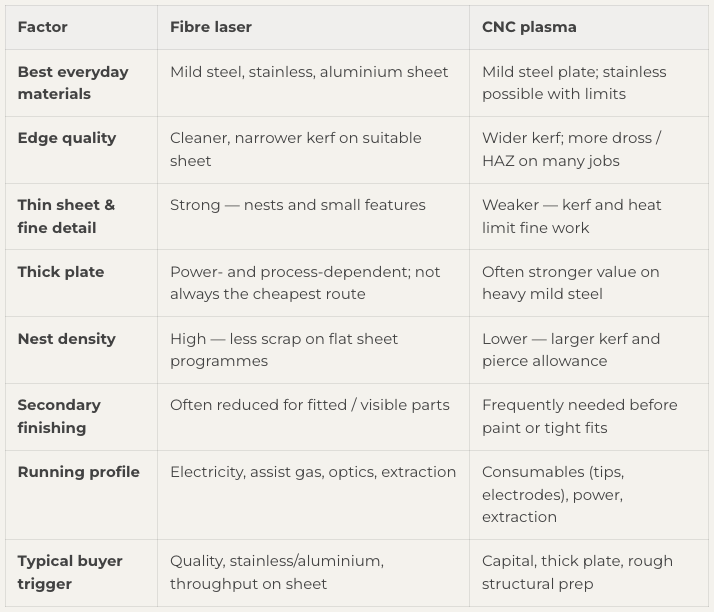
Fibre laser vs plasma — comparison at a glance
Practical comparison for UK sheet metal workshops (typical workshop ranges — confirm capability per machine)
When plasma still wins
Plasma is not obsolete. It remains a sensible primary process when:
- Your mix is dominated by thick mild steel plate where fibre power and gas cost do not pay back cleanly.
- Parts are structural blanks, brackets and frames where edge appearance is secondary.
- Capital budget and floor-space planning favour a robust plasma table first.
- You already have plasma capacity and only need fibre for a minority of stainless or precision sheet work — subcontract or a later fibre cell may be better than forcing one process.
When fibre laser wins
Fibre becomes the stronger default when your quoting depends on:
- Stainless and aluminium sheet with consistent edge quality.
- Tighter dimensional control and denser nests on flat sheet.
- Less grind and dress time before bending, welding or powder coat.
- Repeat production programmes where pierce quality and cut speed on mid-thickness sheet compound across shifts.
- Bringing subcontract laser work in-house with a finish customers will accept without rework.
Vector vs Titan once you choose fibre
Choosing fibre is only the first decision. Bed size and power tier decide which Mantech family fits:
- Vector FL60 / FL90 / FL130 — compact and mid-format enclosed fibre for workshops stepping up from plasma or bureau cutting without a full 3015 footprint.
- Vector FL250 / FL300 — larger Vector beds for higher-duty sheet production.
- Titan N3015 and sibling flatbeds — 3000 × 1500 mm industrial format with higher power tiers for production fabricators.
Safety, extraction and install planning
Both processes need extraction and operator discipline. Fibre laser cells add enclosure, interlock and optics care expectations that differ from an open plasma bay. Plan fume control, power supply and training before the machine arrives — not after the first shift.
Buying checklist before you quote
- List your top five jobs by material, thickness and edge finish — not brochure peak thickness.
- Estimate how much of your mix is stainless / aluminium vs thick mild steel plate.
- Decide whether plasma stays for heavy plate while fibre takes sheet — dual-process shops are common.
- Confirm bed size against your largest everyday nest, not one-off oversized jobs.
- Budget assist gas, extraction, training and service — not only the machine invoice.
- Bring sample DXF files and scrap samples to a demo so edge quality is judged on your work.
Explore Mantech fibre laser cutters
Mantech Machinery UK supplies Vector and Titan fibre laser cutters from Halesowen with UK installation, training and engineering support. If you are moving off plasma for sheet quality — or adding a fibre cell alongside plasma — our engineers can map bed size, kW and extraction to your mix.