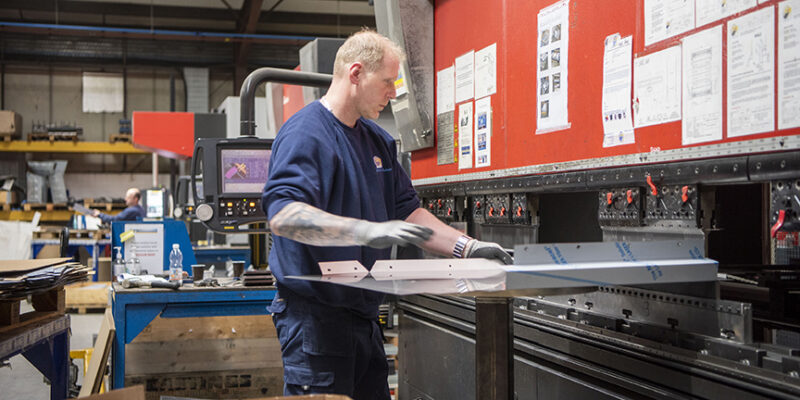
Indispensable in the sheet metal fabrication world, press brakes are used to bend and shape metal in a process known as CNC Folding. It is one of the most important methods of sheet metal bending, turning flat profiles into accurate, functional components.
In use for decades, the progression of technology has seen the press brake evolve from a basic mechanical model into more sophisticated hydraulic, electric and Computer Numerical Controlled (CNC) systems.
Their versatility, precision, efficiency and cost effectiveness for bending and shaping a wide range of metals in varying thicknesses ensure they retain their place as a cornerstone of innovation and excellence in modern metalworking and the wider sheet metal fabrication process.
Yorkshire Laser and Fabrication Ltd have a suite of Amada press brakes, each offering something different by way of capacity and functionality.
What is CNC Folding?
CNC Folding is the process used to bend and fold metals into three-dimensional shapes using a press brake. Also referred to as sheet metal folding or press brake bending, the machine can be used to form both simple and complex components like chassis or frames that require structural integrity without added weight.
How does a press brake work?
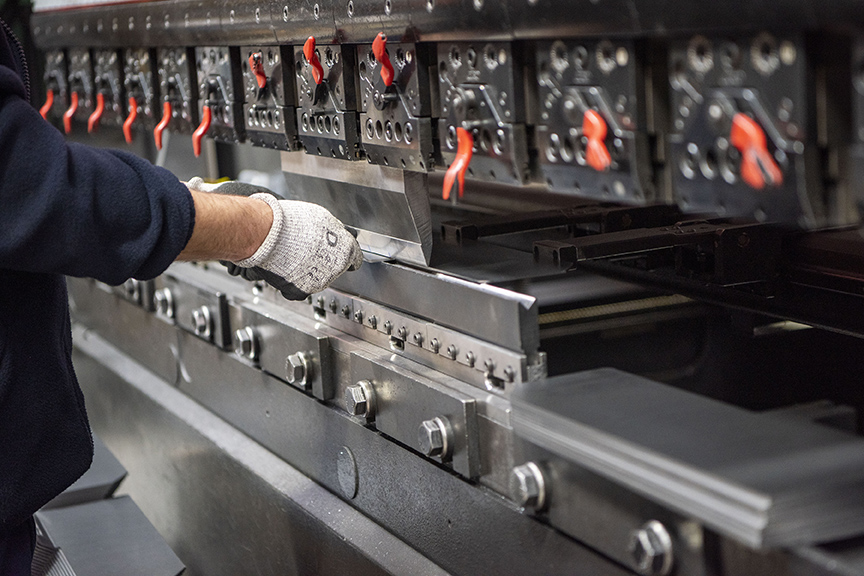
Press brakes use a punch and die system to bend and shape flat sheets into precise angles and complex forms. A precision-controlled back gauge is used to accurately position the part over the die and under the punch prior to the pressing operation. The machine’s upper beam is then lowered under a precise and controlled amount of pressure to accurately achieve consistent folds to tight tolerances.
CNC press brakes are programmed using Computer Aided Manufacturing (CAM) software. This sets the precise bending sequences, angles and back gauge positions ,taking the sheet metal fabrication process from Computer Aided Design (CAD) to production. This link between CAD and CAM is what helps make CNC folding a reliable option for repeatable sheet metal bending, whether the job involves prototypes, one-off components or production runs.
The press operator then selects and installs the right tools for the job according to the programme ready for production to begin.
How are bends and shapes formed?
Press brakes use various bending techniques but the most common ones are:
Air bending: the most common form of pressing on press brakes. It basically presses the material to a given angle in a die that is of greater size than the actual angle required. This means that the material isn’t bottomed in the die, hence it is effectively bent in fresh air, leading to the term air bending. This process is easier on the material being used and the tooling. Because it requires less force than some other forming methods, air bending is widely used in modern press brake forming where flexibility, efficiency and repeatability are important.
Coining: is bottoming a part in a die so using a 90 degree die and pressing the part into it with high tonnage to form it to 90 degrees. This can be useful in certain circumstances with material with low spring back to guarantee consistent angles. Although less common than air bending, coining can still have a place where the application requires a very specific bend angle or reduced spring back.
Yorkshire Laser and Fabrication Ltd have three Amada press brakes:
HD1003NT offering maximum flexibility for small batches. It is quick to set-up, has great accuracy and works at a pressing force of 1000 kN.
HG1003ATC (automatic tool changer) is cost effective and reliable, ideal for general fabrication. A hybrid servo-hydraulic model, it has additional functionality and automated operation which can load complex tool layouts in less than three minutes, greatly driving efficiency.
HD2204NT operating at 2204 kN, this advanced hydraulic press brake is perfect for high volume runs, providing accurate bending at speed. Ideal for intricate designs and exact specifications.
Having a mix of press brakes enables YLF to select the best machine for each job rather than making one size fit all. This ensures we hit the mark on consistency, quality, affordability and the quick turnaround needed for reliable on-time delivery which our customers both appreciate and expect. Their press brakes also work alongside our wider sheet metal fabrication, laser cutting and CNC punching capabilities, allowing flat blanks to move efficiently through the full fabrication process.
Why use CNC folding in modern sheet metal fabrication?
Being able to bend and shape metal to exact specifications offers the sheet metal fabricator many advantages:
Superior precision & accuracy: our CNC press brakes with programmable back gauges, angle measurements and real time adjustments, deliver tight tolerances and excellent repeatability with little room for error or need for rework. This accuracy leads to higher product quality and fewer defects while ensuring parts fit perfectly for assembly. For customers, this means sheet metal folding can support consistent assemblies where every bend needs to align with the next stage of production.
Increased efficiency & productivity: bending metal with a press brake is faster than doing it manually or welding pieces together. Capacity and turnaround time are also enhanced by the ability to execute multiple bends consecutively, and automated features which reduce manual handling and offer out of hours capability.
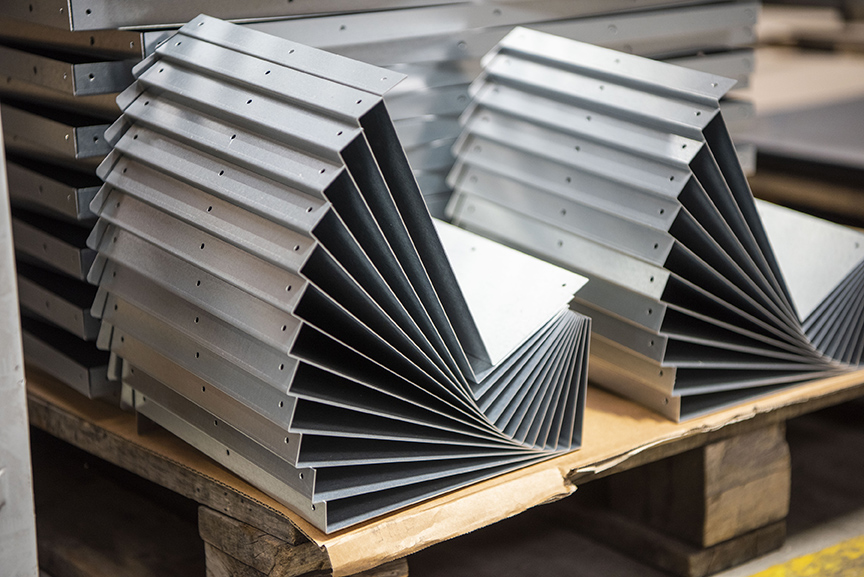
Versatility in terms of the range of metals – mild steel, stainless steel, aluminium, brass and copper – and thicknesses it can handle plus the folds it can create including V-bends, U-bends, channels, hems, deep goose necks and geometric shapes consisting of multiple bends. The adaptability of the machines leads to fast tooling changeovers delivering centring, tapering and deep flange bending suited to small batch or high-volume orders, prototyping or full-scale production.
Cost effective : affordable processing can be passed on to the customer due to savings made through: high accuracy = reduced waste; lower labour and rework costs; good energy efficiency; elimination of secondary operations such as welding. Where the design allows, sheet metal bending can create strength and form from a single piece of material, reducing the need for additional joining or fabrication stages.
Better safety & consistency: CNC and automated systems mean less manual intervention, minimised variability, programmed repeatability and less waste.
Innovation & customisation: Combine CAD, CAM and 3D simulation to experiment with designs and innovation without committing to production. This is a must at YLF where all our customers’ requirements are for bespoke items. We can programme in even complex folds so they can be tried and tested pre-production, reducing trial and error with the finished product.
YLF’s press brakes are a key part of our technological toolbox, giving the company a powerful combination of precision, speed, versatility and cost effectiveness and enabling us to produce efficiently, consistently and affordably the bespoke quality metal parts our customers need from us.
As fabrication demands grow for faster turnaround, tighter tolerances, greater complexity and innovation, CNC Folding delivers on all fronts, helping us and our customers stay ahead of the competition.