When a British aerospace manufacturer took stock of its ageing equipment, it made a bold call and discovered that the best partnerships are built on mutual ambition.
There was a pipe assembly that was produced at Sigma’s facility that once caused a multitude of headaches, where the part was produced from thick-walled Inconel pipe, requiring a 1D bend (meaning the bend radius is exactly equal to the tube’s own diameter). Brutally tight, brutally unforgiving. Two years ago, Sigma’s machines couldn’t reliably pull it off. Today, it rolls off the line without drama. The difference? Three new machines from AMOB, and a partnership that has quietly repositioned Sigma as a world-class benchmark in pipe forming.
A Company at a Crossroads
Sigma makes rigid pipes and sheet metal fabricated assemblies for the aerospace industry, civil overwhelmingly, with some defence, across four sites: Farnborough, Hinckley, and a super-polishing facility in Sandiacre, plus a machining, bending and assembly facility in Chengdu, China.
With around 480 people across the sites, and turnover set to hit circa £52 million this year, it is a significant business. But until recently, it was one with a vulnerability: a heavy dependence on equipment that hadn’t kept pace with the demands of modern aerospace.
“About two years ago, we had a discussion with the board regarding new investment in some of our key capabilities, that hadn’t been done for some time” says Paul Scattergood, Sigma’s operations director. The evidence was stark. One bending machine was 38 years old, and the maximum pipe diameter the company could bend with confidence was 2.5 inches. In addition, with 1D bending becoming increasingly specified by engine manufacturers, chasing fuel efficiency and a smaller engine core, this was somewhat beyond reliable reach.
That last point mattered enormously, as the industry’s trajectory was clear: aerospace had moved from 4D bends to 3D, then 2.5D, and was now demanding 1.5D and 1D as standard.
At the same time, the materials being specified were changing, moving from straightforward stainless steel to Inconel and titanium. Inconel, a heat-resistant superalloy that won’t melt until 1,650°C, is increasingly used to withstand the heat generated by ever more efficient engines.
Then there is titanium, which brings its own challenges with regards to bending tube. Due to its grain structure and a relatively low modulus of elasticity, it always wants to spring back toward its original form, meaning the machines have to calculate an overbend to achieve the drawing requirement. Neither material is forgiving of older, less-advanced equipment.
Meanwhile, Sigma’s strategy was shifting. The company had been pursuing diversification, winning new business with new customers like GE, Collins, and Safran. That was the right move. But new customers bring new, more complex requirements. The old machines were creating scrap, burning time, and holding Sigma back.
Enter AMOB
After engaging with several manufacturers, Sigma settled on AMOB, a Portuguese machine-builder with deep roots in the industrial and shipping sectors, but with clear ambitions to break into aerospace. The fit, it turned out, was natural.
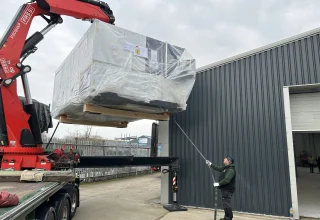
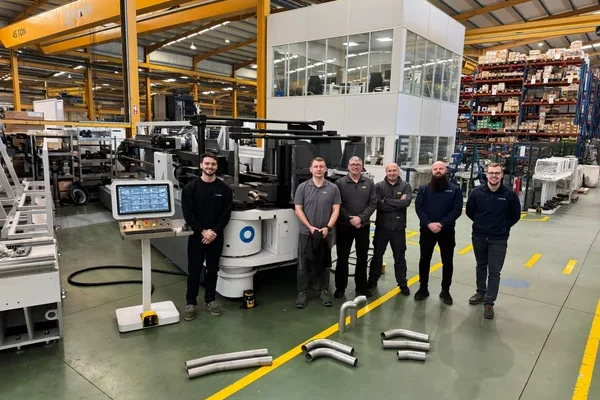
Sigma purchased three full-electric AMOB bending machines: a 52mm model handling pipe up to 2 inches, an 80mm handling up to 3.5 inches, and a flagship 150mm capable of bending pipe up to 6 inches in diameter. All three arrived within weeks of each other, starting in late February last year; in fact, the 150mm machine turned exactly one year old on the day of this interview!
Before a single machine was accepted, Sigma’s engineering Manager Tom Wilson, along with a quality engineer and a bending operator, flew to AMOB’s facility in Portugal for a Factory Acceptance Test. They didn’t bring easy sample parts to prove out. “We took some of the most complex parts we make, some of which were thick-walled Inconel 1D bends that we had been struggling to produce conforming bends,” Tom recalls. “The machines hit all the requirements.” That trip did more than prove the technology; it established trust.
A Mutual Deal
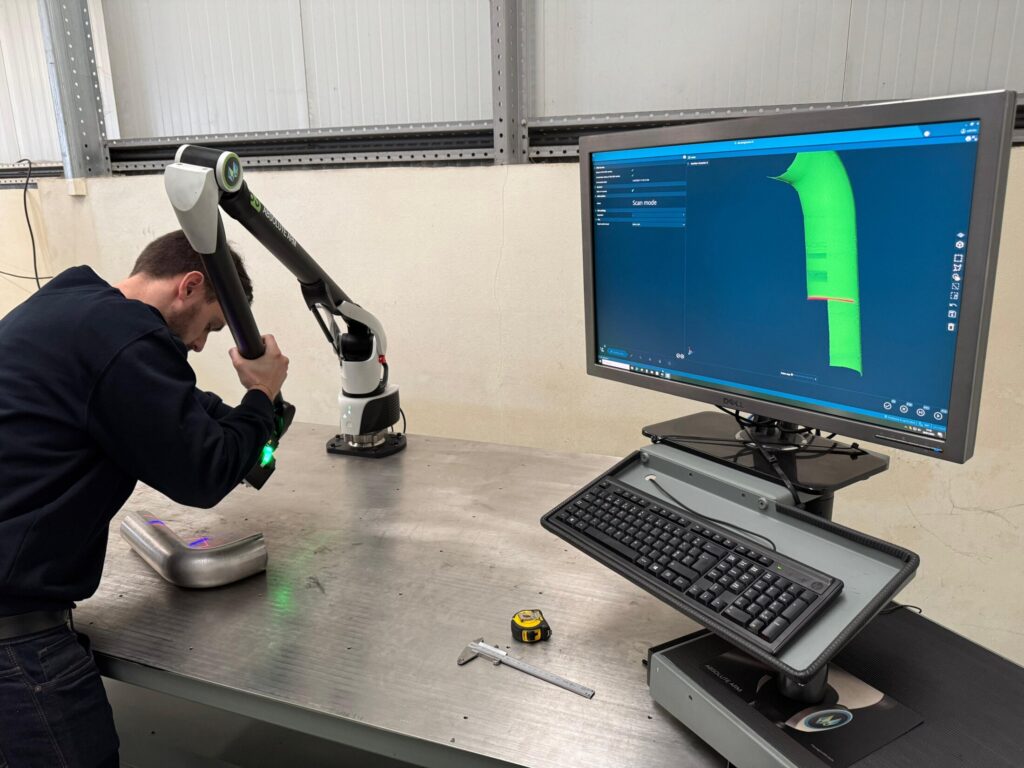
What distinguishes the Sigma/AMOB relationship from a standard equipment purchase is the depth of collaboration on both sides. AMOB handles Sigma’s servicing and when Sigma needs technical support, such as a different approach to a tricky part or a new way to operate the machines, AMOB is there.
But the exchange runs the other way too. “AMOB was mostly involved in industrial and shipping sectors and wanted to get into aerospace,” Paul explains. “We share material specifications with them to help them understand how aerospace materials work.” Stainless steel and Inconel may look similar but forming them is a world apart.
That knowledge shared from Sigma’s accumulated understanding of exotic aerospace materials is exactly what AMOB needed to build credibility in the sector.
The machines themselves have transformed Sigma’s capability. They are multi-stack, allowing various tube sizes to be run without tool changes, and they support bending modes that Sigma’s older equipment simply couldn’t offer.
The machines are accurate, repeatable and the software is simple, user-friendly and being picture-based, requires minimal data entry. Operators pick up the interface quickly. Nine previously problematic parts, Paul notes, “disappeared overnight” once the 80mm machine arrived.
Setting the Benchmark
The investment has had an impact that goes beyond Sigma’s own metrics. Customers including Airbus, GE, and BAE have visited the facility and used a phrase that would have seemed ambitious two years ago: world-class benchmark.
It is a verdict that reflects not just the machines, but the ambition behind acquiring them. The aerospace industry is pursuing engines that run hotter, faster, and leaner which in turn leads to pipe designs that are tighter, made from more exotic materials, and formed to tolerances that were barely conceivable a generation ago. Paul puts it vividly, “Aerospace engines that once used stainless steel pipes in the majority, now require Inconel and Titanium, because the fuel savings and increase in performance with a smaller, hotter core, justifies the cost.”
Sigma, with AMOB, its Portuguese partner, and its three new machines, are supplying the pipes that make that possible. The bend radius keeps getting tighter. The materials keep getting harder. And the company that once couldn’t reliably hit 1D bends in Inconel are now the one others call the benchmark.
“What began as an equipment upgrade became a partnership built on shared ambition — and a step change in capability.”
This article is part of the SMI MACH Publication — the must-read print publication that puts the spotlight on the innovations, partnerships, and people shaping the future of UK manufacturing. Don’t miss the full issue, click here to read more.