When comparing 904L stainless steel vs 316L stainless steel, the key differences lie in corrosion resistance, chemical performance, strength, and cost. While both are austenitic stainless steels, 904L is considered a super austenitic grade designed for highly aggressive environments where 316L may not be sufficient.
If you’re selecting materials for chemical processing, marine applications, or chloride-rich environments, understanding the difference between 904L and 316L is essential.
What is 904L Stainless Steel?
904L (1.4539) is a low-carbon, high-alloy austenitic stainless steel developed for exceptional resistance to strong acids and chloride attack.
904L Chemical Composition
- Chromium: – 20%
- Nickel: – 25%
- Molybdenum: – 4%
- Copper: – 1.5%
- Carbon: ≤0.02%
The high nickel and molybdenum content gives 904L significantly better resistance to:
- Sulphuric acid
- Phosphoric acid
- Chloride stress corrosion cracking
- Pitting and crevice corrosion
904L Corrosion Resistance
904L has a Pitting Resistance Equivalent Number (PREN) of approximately 34–43, making it far more resistant to chloride-induced pitting than 316L.
It is particularly suited to:
- High-chloride marine environments
- Acid processing plants
- Desalination facilities
- Offshore oil and gas applications
What is 316L Stainless Steel?
316L is a low-carbon version of 316 stainless steel and is one of the most widely used corrosion-resistant stainless grades worldwide.
316L Chemical Composition
- Chromium: 16–18%
- Nickel: 10–14%
- Molybdenum: 2–3%
- Carbon: ≤0.03%
The grade also provides good resistance to corrosion in marine and industrial environments but is more susceptible than 904L to:
- Pitting in high-chloride conditions
- Stress corrosion cracking
- Strong acidic exposure
For many general engineering and moderate marine applications, 316L remains a cost-effective and reliable choice.
904L vs 316L: Mechanical Properties Comparison
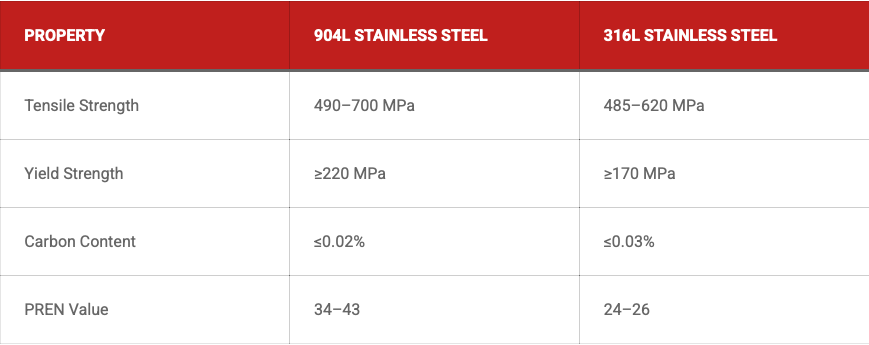
While tensile strength values are similar, the major advantage of 904L over 316L lies in its superior resistance to corrosion rather than mechanical strength alone.
When Should You Choose 904L Over 316L?
Choose 904L stainless steel if:
- Your application involves sulphuric or phosphoric acid
- Chloride levels are high
- Long-term durability in aggressive conditions is critical
- Failure due to pitting would be costly
Choose 316L stainless steel if:
- The environment is moderately corrosive
- Budget constraints are important
- Chloride exposure is limited
- The application is general marine, food, or architectural use
Common Applications of 904L and 316L
904L Applications
- Chemical processing tanks and heat exchangers
- Seawater cooling systems
- Desalination plants
- Gas scrubbing systems
- Offshore oil and gas components
- Pharmaceutical production equipment
316L Applications
- Marine fittings
- Food processing equipment
- Architectural cladding
- Industrial pipework
- General fabrication