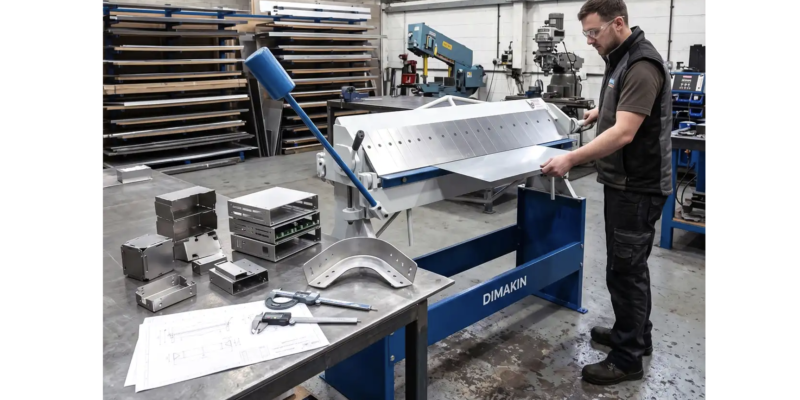
Upgrading from a standard sheet metal folder to a box and pan folder opens up a far wider range of fabrication possibilities.Unlike fixed-beam folders, box and pan folders use removable segmented fingers, allowing fabricators to fold more complex shapes without previously formed sections colliding with the machine frame.
For prototype workshops, HVAC fabrication, enclosure manufacturing, and general sheet metal work, this added flexibility makes it possible to produce parts that would be difficult, or sometimes impossible, on a conventional folder.
Here are five practical folding techniques commonly used with machines such as the DIMAKIN
1. Folding Five-Sided Boxes and Trays
One of the biggest limitations of a standard folder is producing the final fold on a box or tray without crushing the existing sides.
With a box and pan folder, individual beam segments can be removed to match the internal dimensions of the part, allowing the folded sides of the workpiece to sit within the machine during the final bend.
This makes it possible to produce: Trays, Electrical enclosures, Small cabinets, Fabricated boxes, Covers and guards
Workshop Tip
Accurate bend allowance calculations become increasingly important on smaller folded parts, particularly when working close to material capacity or tighter tolerances. Material type, thickness, bend radius, and tooling setup can all affect final fit-up.
2. Producing Deep Offsets and Z Profiles
Deep offsets and Z-shaped folds can quickly become problematic on standard folders due to interference between the folded material and the machine beam.
The segmented finger design of the BP-1316 provides additional clearance around previously folded sections, allowing secondary bends to be formed closer to existing folds.
This is particularly useful for: Mounting brackets, Control panels, Electrical enclosures, Reinforced folded sections
In prototype and low-volume fabrication work, this flexibility can significantly reduce the need for secondary fabrication operations.
3. Hemming for Safer Edges and Added Rigidity
Hemming is commonly used to fold sheet metal edges back onto themselves, helping remove sharp edges while also increasing rigidity.
Open hems and closed hems are widely used across: HVAC fabrication, Architectural sheet metal, Vehicle panels, General fabricated parts
Using a box and pan folder, the material is typically folded to an intermediate angle before being flattened progressively to achieve the final hem.
Important Consideration
Consistent setup and beam adjustment are important when hemming across wider sheet widths, particularly on thinner material where uneven pressure can become more noticeable.
4. Creating Narrow Returns and Internal Flanges
Internal flanges and narrow return folds are often difficult on fixed-beam folders because the formed section interferes with the machine structure.
By rearranging the removable fingers on a box and pan folder, operators can support only the section being folded while allowing the remaining part of the workpiece to clear the beam.
This technique is especially useful for: HVAC transitions, Fabricated ducting, Access panels, Custom folded components
The flexibility of segmented tooling is one of the primary advantages of box and pan folders for prototype and custom fabrication environments.
5. Producing Gentle Radius Folds
Although box and pan folders are primarily designed for straight bends and angular folding, experienced operators can sometimes produce softer bends or approximate radii using progressive forming techniques.
This may involve: Adjusting clamping pressure, Using spacers or mandrels, Performing multiple lighter forming passes
The achievable result depends heavily on: Material thickness, Material type, Bend radius required, Operator experience
For true continuous radius forming, dedicated rolling equipment is generally more suitable, but controlled radius-style bends can still be useful for prototype and low-volume fabrication work.
Why Segmented Folding Matters in Modern Fabrication
The versatility of a box and pan folder comes from its ability to adapt around the shape of the workpiece rather than forcing the workpiece to conform to a fixed beam arrangement.
For workshops producing: Prototype components, HVAC fabrication, Enclosures, Brackets, Custom folded parts
…the flexibility of segmented tooling can significantly expand production capability without moving to more complex CNC equipment.
Like most sheet metal processes, results depend on a combination of: Machine rigidity, Correct setup, Material understanding, Operator technique
With careful setup and accurate layout work, box and pan folders such as the DIMAKIN BP-1316 can produce highly consistent folded components across a wide range of fabrication applications.