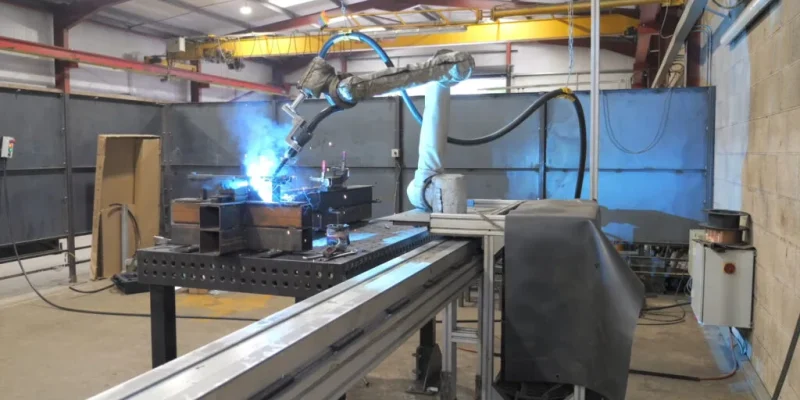
Olympus Technologies Ltd explains – If you are a UK manufacturer under production pressure, a cobot welding rail (track) gives you a fast, practical way to increase production without rebuilding the shop.
One track lets a collaborative robot travel between fixtures, keep arc-on time high, and improve weld quality through steady speed and angle control.
The result is more parts per shift, fewer stoppages, and a layout that uses floor space well.
What A Cobot Welding Rail (track) Actually Is
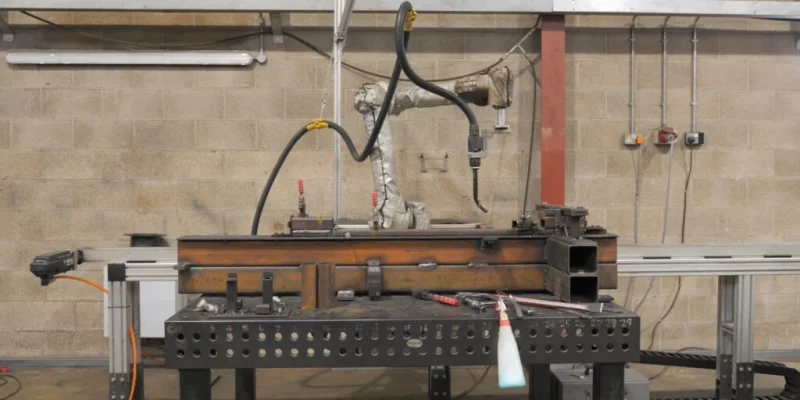
Think of a welding cobot mounted on a servo-driven linear track.
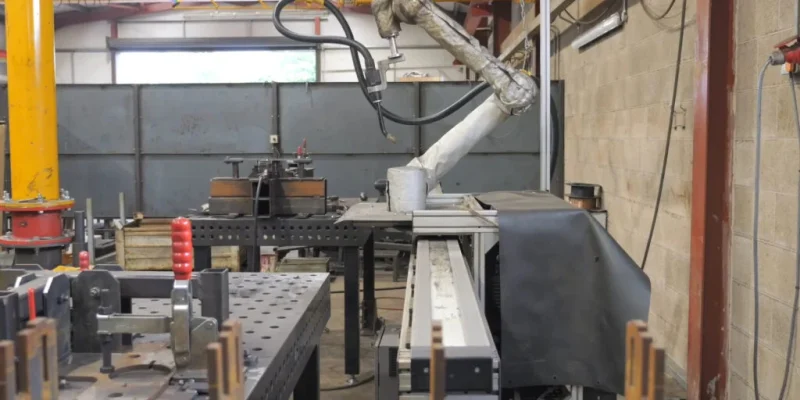
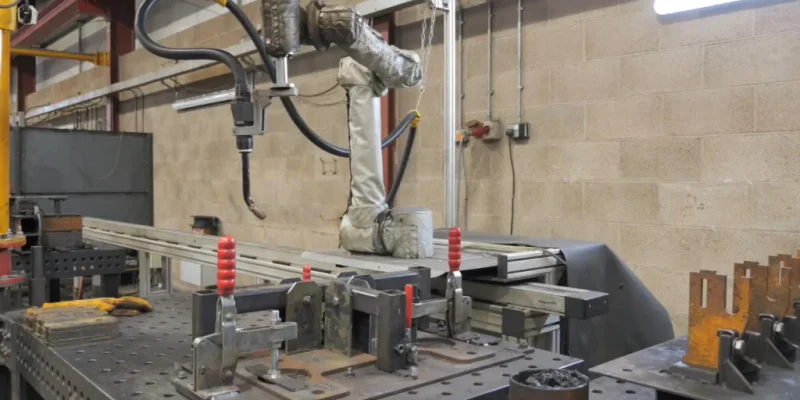
The track becomes an external axis, extending the working envelope so the robot can serve several stations in a single cell. It handles long seams, larger fabrications, and multi-jig setups while keeping travel speed constant.
Compared with a fixed cell, you cover more welding tasks with one coordinated system. It is a modular system that scales as your range expands, and it fits cleanly into existing automation systems on the shop floor.
The Business Case That Moves The Needle
- Increased production without extra robots. Load one station while another is welding. You keep flow steady and output high.
- Improved quality and fewer errors. Consistent travel speed and reliable torch position reduce rework and scrap.
- Smaller footprint per part. One track, several fixtures, smarter use of available space.
- Fast changeovers. Saved recipes and barcoded calls cut downtime on variable mixes.
- Safer work. Less manual welding exposure to heat and fume, and your skilled welders are free to focus on setup, inspection, and programming.
What You Get With Olympus Technologies
- Right-sized hardware. Universal Robots arms with the reach and payload your parts demand, a matched power source, torch and wire feed, and a track sized for stroke, speed, and accuracy. This is proven automation equipment designed for automated welding.
- Clean controls. External axis sync through the UR controller, tidy URCap menus, and the most-used commands placed top right corner on the HMI so operators find them fast.
- Robust fixtures and welding tools. Modular jig tables, positioners, and turntables to access every weld without compromise.
- Complete system design. Extraction, cable management, guarding, and safety devices specified to standards, then integrated as one reliable system.
Layouts That Keep The Arc On
- Inline track. A simple load, weld, unload loop that maintains flow and protects productivity.
- U-shaped track. Compact under shared fume hooding when available space is tight.
- Shuttle tables. Keep welding while fixtures swap, reducing breaks and protecting uptime.
Before installation, the company confirms power, air, extraction, access routes, and floor flatness so the operation is smooth and the system performs as expected.
Picking A Package That Fits Your Work
Start with the part envelope and joint types, then set a realistic throughput target based on beads per part, cycle time, and an achievable arc-on ratio.
Size the track for stroke, speed, and accuracy, and add a column lift where height is the limiting factor. Choose the right process and consumables for your materials.
Lock in the safety concept early, including collaborative speeds, scanners or light curtains, and interlocks. If forming is part of the flow, adjacent fab automation such as Press Brake Tending is a natural fit.
Programming Made Straightforward
Olympus Technologies teach clean paths, set weave parameters, and enable touch sensing or seam tracking where parts vary. Recipes and WPS parameters are stored and version controlled, with barcode job calls and fixture offsets.
Operators see a simple screen where they can pause, accept, continue, and select the next job without digging through menus. This keeps operations consistent and makes training shorter and more effective.
Proof In The Numbers
Track arc-on percentage, parts per shift, first-pass yield, rework rate, and consumable use. A clear ROI view connects investment to outcomes: labour saved, scrap avoided, and extra throughput, divided by capex.
Tracks often shorten the payback period by lifting OEE and making multi-station work easy to run. You can expect solid scalability as production demands grow because the same platform can expand with more stations or longer stroke.
Fixed Cell vs Track Cell

Maintenance That Protects Uptime
Daily checks cover torch wear, liner, tip, nozzle, wire path, and track lubrication. Quarterly, we verify calibration, check backlash, and validate safety devices.
Because the track and fixturing are modular, upgrades are simple to add: longer stroke, vision add-ons, positioners, and offline programming. Keeping downtime low and value high for your customers.
Where tracks Reach Their Limits
Very heavy or complex parts may need rotate and tilt positioners to maintain access and control. Heat distortion can be managed with stitch or weave strategies, clamping, and lower heat input.
For thin or reflective materials, Olympus Technologies often recommends parameter tweaks or the Laser Welding route.
Manual Welding Still Has A Place
There are times when manual welding wins on turnaround or one-off jobs. A track cell does not replace your team. It complements them.
Automated welding carries the load on long runs, repetitive seams, and parts that benefit from consistent speed, while skilled welders handle prototypes, complex repairs, and first articles.
The benefits show up as better use of talent and higher overall productivity.
Upstream and Downstream Fits
- Machine tending. Pre and post machining around the track cell reduces handling and queue time. See Machine Tending.
- End-of-line flow. When SKUs need packing or pallets, see Case Packing and Palletising.
- Sealant and bead work. Add precise adhesive control before or after weld with Dispensing and Sealing.
Training, Handover, And Team Adoption
Olympus Technologies provides focused training that fits your operation. Operators learn barcode job selection, safe recovery, and basic program edits. Technicians go deeper on WPS control, fixture offsets, and URCap usage. The goal is a cell that is suitable for day-to-day running by your existing workforce, with confidence to adapt when the product mix is variable.
Ready To See Your Track In Action?
Get a free, no-obligation discovery call, a track layout concept, and an outline payback model tailored to your parts. Start here: Welding Automation.