When sourcing sheet metal fabrication, price and lead time are naturally important considerations. But before a component is folded, machined, welded or assembled, it often begins with one critical process: laser cutting.
The quality and accuracy of that first cut can influence every subsequent manufacturing stage.
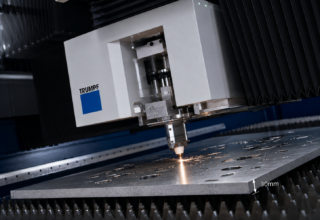
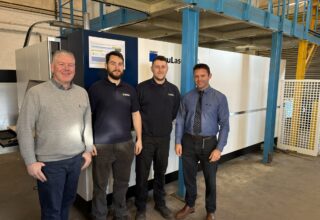
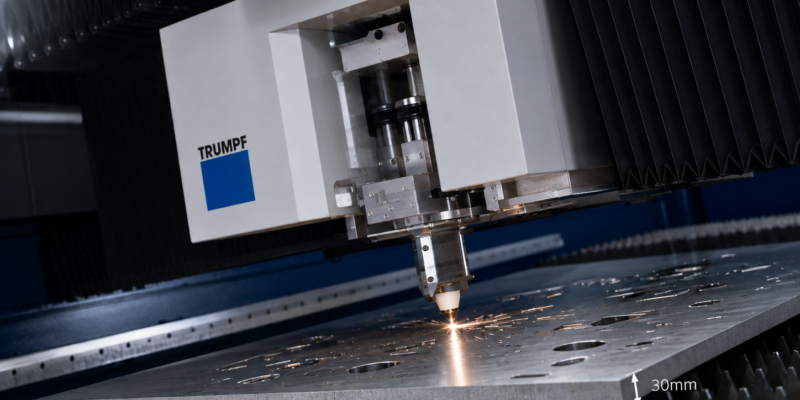
Grenville Engineering invested in a TRUMPF TruLaser Fibre 12kW at the end of 2025, increasing its laser cutting capability and providing greater flexibility across a wide range of materials and thicknesses. The investment supports everything from one-off prototypes through to repeat production, alongside the company’s wider in-house fabrication capabilities.
But what does a 12kW fibre laser actually mean for engineers and buyers?
More Than Just Power
Higher laser power is not simply about the ability to cut thicker material. It also enables efficient processing across different materials and thicknesses while maintaining the accuracy and edge quality required for subsequent manufacturing operations.
Grenville Engineering’s TRUMPF TruLaser Fibre 12kW can process:
* Mild steel up to 30mm
* Stainless steel up to 40mm
* Aluminium up to 30mm
* Brass up to 12.7mm
* Copper up to 12.7mm
With a 1500 x 3000mm bed size, the machine provides the flexibility to manufacture components for industries including earthmoving, construction, medical and industrial equipment, as well as other sectors requiring precision-engineered fabricated parts.
The First Process That Sets the Standard
For many fabricated components, laser cutting is the first stage of manufacture.
Every bend, weld and assembly that follows relies on the accuracy of the initial profile. A clean, precise cut helps components fit together correctly and allows subsequent manufacturing processes to run efficiently.
At Grenville Engineering, laser cutting can be followed in-house by CNC forming, machining, welding, assembly and inspection. Keeping these processes together allows greater control over the manufacturing journey and helps maintain accuracy and consistency from one operation to the next.
Why Thick Laser Cutting Matters
One of the key advantages of a 12kW fibre laser is its ability to process thicker materials while maintaining good edge quality.
For customers, the benefit extends beyond simply being able to cut thicker plate. A high-quality cut can mean components require less additional preparation before progressing to bending, machining, welding or assembly.
Benefits include:
* Excellent dimensional accuracy
* Consistent edge quality
* Reduced secondary finishing
* Reliable repeatability
* Greater manufacturing efficiency
Whether producing a one-off prototype or repeat-production parts, reducing unnecessary secondary operations can improve efficiency and avoid delays further down the manufacturing process.
Faster Processing, Better Productivity
Higher laser power can also improve productivity across a range of material thicknesses.
For Grenville Engineering, this provides greater flexibility when managing different customer requirements, from rapid prototypes and smaller batches through to ongoing production schedules.
The objective is not simply to cut material faster. The real value lies in how that increased capability can improve the efficiency of the broader manufacturing process while maintaining consistent quality.
More Than Laser Cutting
Laser cutting may be where many projects begin, but it is only one part of Grenville Engineering’s manufacturing capability.
Its laser cutting services are supported by a comprehensive range of in-house processes, including:
* Tube laser cutting
* CNC punching
* CNC press braking
* CNC machining
* MIG, TIG and robotic welding
* Assembly and inspection
Bringing multiple processes together under one roof can mean fewer supplier handovers, improved communication between manufacturing stages and greater control over quality from prototype to production.
It also gives Grenville Engineering’s team the opportunity to consider the complete manufacturing process rather than viewing each operation in isolation.
Investing in Better Manufacturing
For Grenville Engineering, investment in manufacturing technology is not simply about adding another machine to the shop floor.
The purpose is to increase customers’ capability, flexibility, and manufacturing efficiency.
For engineers, this can mean producing components with high accuracy that are ready for subsequent manufacturing operations. For buyers, it provides access to a manufacturing partner that can manage multiple stages of sheet-metal fabrication in a single facility.
Grenville Engineering’s investment in 12kW fibre laser technology is therefore about more than cutting power. It strengthens the first stage of a wider manufacturing process, supporting quality, efficiency and consistency from prototype to production.